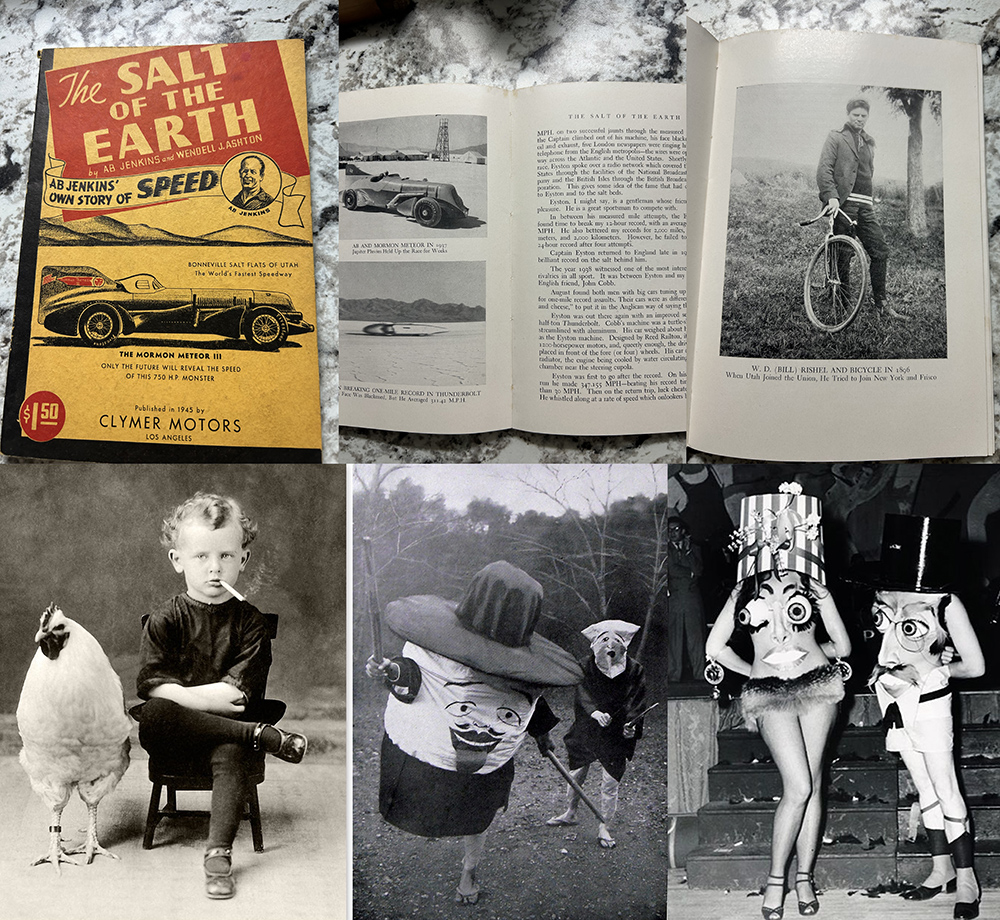
The story begins with W.D. “Bill” Rishel, who in 1896 had a dream so audacious that physics itself took notice, hired a lawyer, and began drafting a strongly-worded letter about the importance of respecting natural laws. Bill’s dream was simple: he wanted to pedal his bicycle from Utah to both New York and San Francisco. At the same time. Not one after the other, mind you, which would have been merely exhausting and possibly fatal given the state of 1890s roadways (which is to say, nonexistent). No, Bill wanted to arrive at both destinations simultaneously, thereby becoming the first human being to achieve what theologians called “bi-locational ambulation” and what everyone else called “completely batshit insane.”
The idea had come to him at a church social in Provo, where the punch bowl had been spiked with something the organizers referred to as “Brother Jedidiah’s Special Tonic,” which was actually fermented prickly pear juice mixed with what might have been kerosene but was probably worse. After consuming roughly a gallon of this substance (Bill had been very thirsty, and the punch was surprisingly refreshing with just a hint of notes that suggested “industrial accident” and “poor life choices”), Bill found himself lying face-down in a irrigation ditch, communing with the desert.
The desert, it should be noted, is a terrible conversationalist. It mostly just hums and occasionally makes ominous cracking sounds. But on this particular evening, possibly because Bill had achieved a blood-alcohol content that would have killed a horse or possibly because the universe was bored and looking for entertainment, the desert actually spoke back. The message was clear: velocity wasn’t just about getting places faster. Velocity was about restructuring the fundamental architecture of reality so that concepts like “place” became more like suggestions than actual limitations.
The vision also included specific instructions about trusting chickens and fearing entities with disproportionately large heads, which seemed at the time like the kind of thing hallucinations typically threw in for flavor, but which would turn out to be the most important goddamn thing Bill had ever heard, had he been sober enough to write it down properly. What he actually scrawled in his journal was: “CHIKN = YES, BIG HED = NO NO NO,” followed by a surprisingly detailed sketch of what appeared to be a bicycle transcending several planes of existence at once.
Bill’s experiment, launched three weeks later after he’d convinced himself he hadn’t just been supremely drunk, failed spectacularly. He made it exactly fourteen miles from his farmhouse before his bicycle, a Schwinn Roadster that had, up until that moment, been a perfectly serviceable piece of equipment with no particular feelings about existential paradoxes, suddenly became aware that it was being asked to transport a human being to two mutually exclusive geographic locations simultaneously. The bicycle, confronting this logical impossibility, did what any rational object would do when faced with an insurmountable contradiction: it experienced a metaphysical crisis so profound that it simply disintegrated into its component atoms, leaving Bill sitting on absolutely nothing at forty-three miles per hour.
The subsequent crash left Bill with a broken collarbone, a shattered sense of cosmic purpose, and a profound respect for chickens, which he noticed were completely unbothered by the fundamental nature of reality. Chickens, Bill realized, existed in a state of such complete indifference to the universe that they were effectively immune to its rules. A chicken could be in a coop and simultaneously pecking at something seventeen feet away and not give a single solitary damn about the paradox. This, Bill understood, was the secret to everything.
He walked home, dejected but enlightened, and founded the Velocity Cult, a secret society dedicated to achieving speeds great enough to make reality negotiable. The cult’s membership peaked at seven people, mostly because Bill’s recruitment pitch included the phrase “you might disintegrate” and also because nineteenth-century Utah had limited interest in experimental transportation metaphysics.
Fast forward forty-one years to 1937, where we find ourselves on the Bonneville Salt Flats, which is essentially what happens when God decides to iron a section of Utah until it’s flatter than a two-dimensional mathematical concept and approximately as interesting. The Velocity Cult had evolved considerably since Bill’s era. They’d dropped the robes (impractical at high speeds), streamlined their doctrine (from a seventy-three-page manifesto to the much pithier “Go Fast, Break Reality”), and somehow convinced several wealthy industrialists that land speed racing was a legitimate sporting endeavor rather than a thinly-veiled excuse to tear holes in the fabric of spacetime.
The cult’s new high priest was a gentleman named AB Jenkins, who had the kind of square-jawed determination that suggested he’d been carved from granite by a sculptor who really believed in destiny. AB piloted a vehicle called the Mormon Meteor III, which was essentially a 750-horsepower middle finger to the laws of physics, shaped vaguely like what would happen if an airplane got extremely drunk and had relations with a luxury sedan. The thing was so aerodynamic that wind resistance filed a formal complaint.
AB Jenkins had inherited Bill Rishel’s journals, which he’d discovered in a trunk in his grandfather’s attic next to a dead possum and seventeen issues of a magazine called “Ladies of Moderate Virtue and Agricultural Interest.” The journals were written in a combination of English, frantic sketches, and what appeared to be some kind of code that turned out to just be Bill’s handwriting after the third jar of Brother Jedidiah’s Special Tonic. But the warning was clear, once AB decoded it: at approximately 350 MPH, reality becomes “squishy” (Bill’s technical term, underlined three times). At this velocity, the barriers between possible timelines begin to blur, wobble, and occasionally fall over like a drunk trying to navigate a ship’s deck during a hurricane.
What Bill’s journals didn’t mention, because Bill had died in 1903 after an incident involving a steam-powered unicycle that we needn’t get into, was that the British were also aware of the phenomenon. Captain George Eyston, a dashing English racing enthusiast who wore his driving goggles with the kind of aristocratic flair that suggested he’d been born in them, had discovered the same velocity threshold during a 311.42 MPH run in his vehicle, the Thunderbolt. The Thunderbolt was painted a peculiar shade of silver that seemed to shift colors depending on who was looking at it, which should have been everyone’s first clue that something was deeply wrong with the entire enterprise.
During that 311.42 MPH run, and it’s worth noting that .42 was later determined to be the exact decimal point at which reality stops being a fixed state and becomes more of a loose agreement between particles, Eyston felt something that he later described in his diary as “a tremendous sense of displacement, as though I’d driven through a curtain made of numbers.” When he stopped the vehicle and climbed out, his face blackened with oil and exhaust, five London newspapers were waiting for him. Which was odd, because five London newspapers hadn’t been there when he’d started the run, and also because he was in Utah, approximately 4,700 miles from London.
The reporters began shouting questions about something called “the Empire State Building Incident” and asking him to comment on “the party coordination failures” and whether he took responsibility for “the giant head situation.” Eyston, who had no idea what any of this meant and was frankly more concerned about the fact that reality appeared to be leaking, politely declined to comment and suggested they all have a nice cup of tea and perhaps a lie-down.
Then he turned around and saw them: two entities standing on the salt flats, backlit by the setting sun, wearing heads the size of washing machines.
One appeared to be designed as a cheerful city building with arms and legs, its face frozen in a rictus grin that suggested it had seen the heat death of the universe and found it moderately amusing. The other was a sailor, or possibly a dog, or possibly a sailor-dog hybrid created by someone who had fundamentally misunderstood what sailors and dogs were individually, let alone in combination. Both were performing what might have been a dance, or might have been the physical manifestation of a dimensional intersection error, moving in perfect synchronization to music that didn’t exist in this timeline but could be faintly heard if you listened with your spleen instead of your ears.
The entity claiming to be “Mister Building” (its actual name was unpronounceable in any human language and sounded like architecture having an orgasm) explained in a voice that seemed to come from three feet to the left of its actual mouth that they were from a dimension where buildings were sentient, celebrated birthdays, and, this was apparently the important part, everyone was legally required to wear novelty heads in public. Not wearing a giant novelty head in their dimension was considered obscene, like walking around with your skeleton showing. Which, technically, everyone in our dimension does all the time, but the Building didn’t want to be rude and point that out.
The sailor-dog creature, who went by “Jolly Pete” and had a backstory involving a 1934 motorcycle accident that he absolutely refused to discuss beyond saying it was “embarrassing and involved a misunderstanding with a pretzel cart,” explained that they’d been attending the Empire State Building’s eighth birthday party in 1939 when Eyston’s velocity breach had created a temporary wormhole. They’d stumbled through it, thinking it was the bathroom, and now found themselves in 1937 Utah, which was considerably less interesting than the bathroom would have been.
This presented several problems, the least of which was the temporal paradox of people from 1939 appearing in 1937, and the most significant of which was that their presence in our dimension was already causing what scientists would later call “mascot contamination.” Within hours of their arrival, three people in California spontaneously decided that what the world needed was a restaurant where a giant mouse sang songs to children. Two more people in Kansas developed detailed plans for a theme park staffed entirely by people in body suits depicting anthropomorphized vermin. The contamination was spreading.
AB Jenkins, who had rushed to the scene after hearing reports of “British people and geometric shapes appearing from nowhere,” immediately recognized the situation for what it was: exactly what Bill Rishel had warned about. He made one phone call, to a small farm outside Salt Lake City, and said only: “Get the chicken. We need her now.”
This is good – I’m getting more of the voice now. Let me continue with more elaborate, meandering descriptions and absurd details. I need to bring in the chicken in a big, elaborate way, and tie everything together with more callbacks and running gags.
The chicken arrived three hours later in a special transport crate labeled “TEMPORAL ANCHOR – HANDLE WITH INDIFFERENCE,” driven by a young man who would later become famous for an entirely unrelated incident involving a grain silo and a local politician’s toupee. This was Bill Rishel’s great-great nephew, also named Bill because the family had severe imagination problems when it came to names, and he was carrying a Rhode Island Red hen named Duchess II, granddaughter of the original prophecy chicken.
Duchess II was, by all accounts, the most extraordinarily ordinary chicken who had ever lived. She pecked at things. She made noises that sounded like a small motor trying to start. She had no opinions on philosophy, velocity, or the fundamental nature of spacetime, and this, this, was precisely what made her invaluable. See, consciousness creates reality by observing it. Schrödinger had figured this out with his cat thing (though he’d gotten several critical details wrong, primarily about cats, who are actually aware of all possible quantum states simultaneously and choose to ignore them because cats are assholes). But chickens? Chickens operated on a level of awareness so profoundly disconnected from abstract concepts that they existed in a state of quantum immunity. A chicken couldn’t collapse a wave function if you paid her in premium scratch grain and a lifetime supply of worms.
Young Bill (we’ll call him “Bill Jr.” to avoid confusion, even though he was actually Bill IV) approached the dimensional refugees with Duchess II tucked under his arm and a candy cigarette dangling from his mouth because he was seven years old and thought it made him look tough. It did not make him look tough. It made him look like a child who was about to experience something that would require decades of therapy to process.
“Right,” said Bill Jr., with the confidence of someone who had no idea what he was doing but had been assured by several adults that it would “probably be fine.” “Duchess, do your thing.”
Duchess II pecked at the ground near Jolly Pete’s feet, completely indifferent to the fact that those feet existed in a state of quantum uncertainty, being simultaneously in 1937 and 1939 and also briefly in 1642 during what historians called “The Great Chicken Incident of Suffolk” but refused to discuss in detail. The chicken’s absolute, profound lack of interest in the paradox created what temporal physicists would later describe as a “reality anchor point”, a fixed location in spacetime around which all the contradictory timelines could reorganize themselves.
The effect was immediate and somewhat disturbing. Jolly Pete began to vibrate at a frequency that made everyone’s teeth hurt and caused three nearby jackrabbits to file for divorce. Mister Building started flickering between solid, transparent, and what appeared to be a mathematical equation describing the architectural principles of futility. The air around them began to smell like birthday cake and existential dread, a combination that would later inspire a Vegas buffet theme.
Then, with a sound like a door slamming in a hallway that didn’t exist, they were gone. Sort of. They’d been returned to their proper dimension and timeline, though AB Jenkins would later discover that in doing so, they’d left behind what he called “conceptual residue”, the idea of giant novelty mascots had been permanently embedded in our timeline like a splinter in the collective consciousness of humanity.
Within six months, the first sports team had debuted a mascot. Within five years, Disneyland would open with people voluntarily wearing full-body character costumes in 90-degree heat, claiming it was “fun” and “entertaining” rather than acknowledging it as a symptom of dimensional contamination. By the 1970s, Chuck E. Cheese would appear, and absolutely nobody questioned why a rat with the voice of a middle-aged man was hosting children’s birthday parties. The contamination was complete.
AB Jenkins documented all of this in his 1945 memoir “The Salt of the Earth,” published by Clymer Motors for $1.50 (approximately $27 in today’s money, which was still a bargain for information about how to prevent dimensional incursions through land speed racing). The book sold exactly forty-three copies, forty-one of which were bought by Velocity Cult members, one by a librarian who thought it was about soil conservation, and one by Captain Eyston, who wrote AB a polite thank-you note and never spoke of the incident again, except once when he was quite drunk at a dinner party and told everyone that Jolly Pete had given him a recipe for interdimensional scones that he’d been too frightened to try.
The book became a collector’s item not for its racing insights, which were considerable and included the phrase “never exceed 347 MPH unless you’re prepared to have a conversation with your own grandfather’s ghost about why you’re such a disappointment”, but because the Velocity Cult, now operating under the name “The Institute for Responsible Acceleration Studies,” bought up every copy they could find to prevent the general public from learning several uncomfortable truths. Chief among these: Chuck E. Cheese wasn’t from New Jersey. He was from the Big Head Dimension, sent through deliberately in 1977 as a reconnaissance agent tasked with gathering intelligence on human children’s birthday parties and reporting back on their structural weaknesses.
To what end, nobody knew. But the Velocity Cult took no chances. They maintained a standing watch at all major racing venues, armed with chickens and detailed instructions about what to do if someone accidentally opened another portal. The instructions mostly consisted of “DON’T BE ALARMED” in large, friendly letters, followed by seventeen pages of very specific reasons to panic, and then a final page that said “SERIOUSLY THOUGH, FIND A CHICKEN.”
Bill Rishel’s original bicycle still exists, in a manner of speaking. Its atoms were scattered across seventeen square miles of Utah desert during the Great Disintegration of 1896, but atoms, it turns out, retain a kind of memory. Local physicists, the ones who are aware of the situation and have signed multiple non-disclosure agreements, report occasional anomalies where the bike briefly rematerializes, ridden by all possible versions of Bill simultaneously. These versions include Bill the Successful (who made it to both coasts), Bill the Dead (who didn’t survive mile fifteen), Bill the Transcendent (who achieved velocity enlightenment and became a being of pure speed), and Bill the Confused (who ended up in Delaware and never figured out why).
The bicycle appears most frequently on Tuesday afternoons at 3:47 PM, though nobody knows why Tuesday, and everyone’s afraid to ask. When it manifests, it exists for exactly 4.3 seconds before vanishing again, and during those 4.3 seconds, anyone who looks directly at it experiences a profound understanding of velocity as a spiritual concept, followed immediately by a nosebleed and an overwhelming craving for soup.
The chicken descendants continue their vigil, passed down through generations like a fuzzy, pecking heirloom. The current guardian is Duchess VII, who lives on the same farm in Virginia (the family moved east in 1952 after an incident involving a uranium mine, but that’s another story), and who maintains the same tradition of profound indifference that has protected our reality for over a century. She pecks at feed. She makes disapproving noises at the family pig. She exists in a state of quantum immunity, unknowing and uncaring that she is humanity’s last defense against the mascot dimension.
Because here’s the truth that AB Jenkins, Bill Rishel, and everyone else involved eventually understood: speed isn’t the goal. Speed was never the goal. Speed is simply the mechanism by which we discovered that reality is far more fragile and negotiable than anyone suspected, and that the barriers between what is and what could be are roughly as substantial as wet tissue paper.
The real goal, the actual, honest-to-God objective, is to not open portals to dimensions where everyone wears giant novelty heads and thinks this is normal.
Speed is just how we got into this mess in the first place.
And somewhere, in the Big Head Dimension, Mister Building is planning Mister Parking Garage’s birthday party, and they’re all wondering when the next person is going to drive fast enough to punch another hole in reality so they can come back through, this time with proper party supplies and a better understanding of human geography.
The Velocity Cult watches. The chickens wait. And every mascot you’ve ever seen at a sporting event or theme park is smiling that giant, unblinking smile, knowing something you don’t.
Sleep tight. And if you’re ever at Bonneville Salt Flats and you see a chicken wandering around looking disinterested, for God’s sake, don’t bother her. She’s working.


