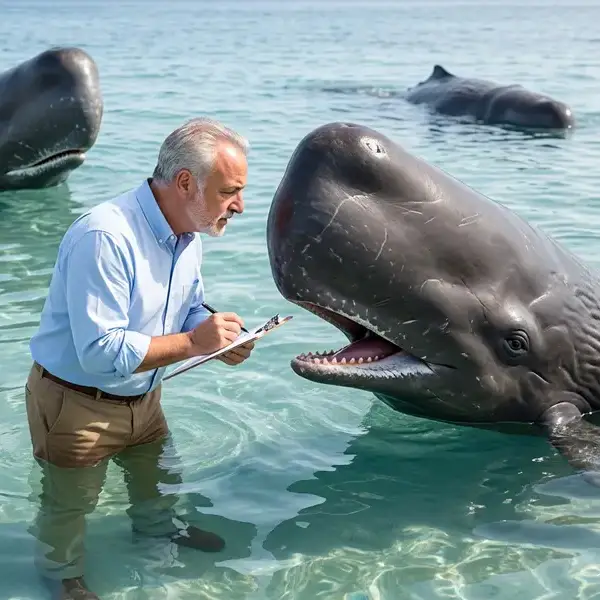
Estimated reading time: 7 minutes
For years, scientists assumed sperm whale communication was essentially fancy clicking. Rhythmic. Intentional. But fundamentally unknowable, like a coworker who only communicates via calendar invites and never shows up to the meeting.
That assumption, it turns out, was wrong.
Researchers at Project CETI, a nonprofit dedicated to decoding sperm whale communication, have discovered that those clicks aren’t just rhythmic patterns. They contain vowel-like sounds, called “a-codas” and “i-codas,” that appear in structured sequences paralleling the way human languages use vowels to carry meaning. The study was published this week in Proceedings of the Royal Society B, and I have read it extremely thoroughly, by which I mean I read the headline and two paragraphs and immediately began imagining two sperm whales named Dave and Phil complaining about the commute.
“On the surface, these vocalizations sound like this alien, ocean intelligence that has nothing to do with us,” said lead author Gašper Beguš, a linguist at UC Berkeley.
The š in Beguš is not a typo. It is a diacritical mark called a háček (the word háček contains its own háček, which is either elegant or a cry for help), used in several Slavic languages, and producing it on a standard keyboard requires a series of keystrokes normally reserved for unlocking the hidden settings menu on a European appliance. His parents, one can only assume, wanted him to spend his formative years building character. He became a linguist, which tracks.
“But when you actually look at it closely,” Beguš continued, “you realize, ‘Oh, we’re way more similar.'”
Dave and Phil have been saying this for years. You will meet them shortly.
The Science, Briefly, Before We Get to the Good Part
The mechanics here are genuinely fascinating. Sperm whales produce their clicks by flapping what researchers call “phonic lips” inside their nose, which is a sentence I will never fully recover from. I once dated a girl in high school who went by “Phonic Lips.”
Okay.
That’s a lie.
I did not date in high school. I did, however, win a Dungeons and Dragons tournament, so the decade was not without its triumphs.
These clicks combine into rhythmic series called codas, and for a long time scientists treated the patterns like a code to be cracked, focusing almost entirely on timing and rhythm.
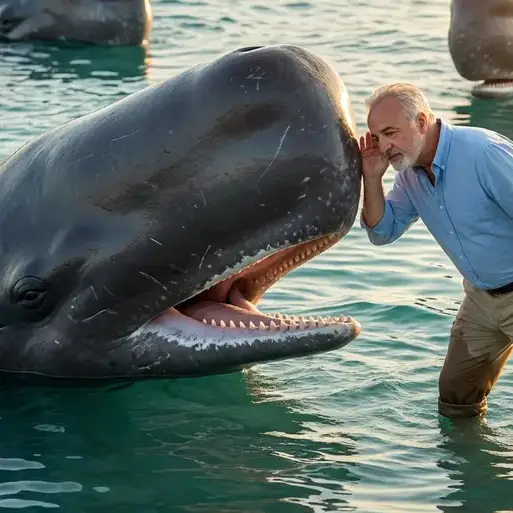
But last year, researchers realized the clicks weren’t all the same. They varied based on something called a “formant,” the technical term for the frequency relationship that determines vowel sounds in human speech. You change a vowel by reshaping your mouth and throat. Sperm whales do it by reshaping a structure inside their nose called the distal air sac (My nickname in high school was “Distal Air Sac,” which is probably why I didn’t date.). Different method, same result: two distinct vowels, deployed in complex, patterned sequences.
Whether any of this actually adds up to language remains an open question. “We don’t know for certain whether they carry meaning,” said Beguš. But the fact that the patterns are structured, not random, suggests the whales are actively choosing which vowel type to use.
Which means the aforementioned Dave and Phil have been making choices in there this whole time. And based on the available evidence, those choices probably sound something like this.
A Transcript of Whale Conversations, As Best As Science Can Determine
Dave: Phil. Hey. Phil.
Phil: [clicks twice in a-coda pattern] Yeah.
Dave: You see the current this morning? Coming up from the trench?
Phil: Don’t get me started. I budgeted forty-five minutes to get to the feeding grounds and it took two hours. Two hours, Dave. I had to breathe twelve times.
Dave: There’s a dead zone near the canyon. Construction or something. They’ve had a baleen whale carcass sitting there since November.
Phil: Yep. November. The whole ecosystem grinding to a halt because nobody wants to deal with it. And you know who’s going to deal with it? The hagfish. The hagfish always deal with it. They show up, everyone acts disgusted, job gets done. Nobody ever says thank you to the hagfish.
Dave: You think about the hagfish a lot.
Phil: I think about a lot of things, Dave.
Meanwhile, Six Hundred Feet Away
This would also be a good time to introduce Gary.
Gary is not part of Dave and Phil’s pod. Gary is, to use the scientific term, a situation. He tends to show up at social aggregations having already been heavily into the fermented squid, and his participation in any conversation can best be described as thematic rather than responsive.
Dave: So I’m saying we look at deeper water. Get away from the shipping lanes, better squid access, quieter overall. Deborah’s been on me about it for months.
Phil: It’s a big move. What about the calves?
Dave: The calves are fine. They’ll adapt.
Phil: [long pause in i-coda pattern] That’s what you said about the bioluminescent zone.
Dave: The bioluminescent zone was a phase.
Gary: [from somewhere in the middle distance]
I AM SPERM.
Dave: Gary.
Gary: I AM. SPERM. I am SPERM whale. That is my name. I am made of SPERM. Scientifically. Humans looked at me and said: that one. That one right there. SPERM.
Phil: We’ve talked about this.
Gary: They named me after a substance that comes OUT of them, Phil. Out of them. Into a context. And that context is MY NAME.
Dave: The name actually refers to spermaceti. It’s a waxy organ in the head. It helps with buoyancy and…
Gary: I AM SPERM.
Dave: It’s not…
Gary: I AM SPERM WHALE AND I LIVE IN THE OCEAN AND I WILL NOT BE CALMED.
Phil: He’s going to do this all night.
Gary: I. AM. SPERM.
Back to Dave and Phil, Because Adults Are Present
The new vowel research also found that a-codas tend to be shorter than i-codas, and that i-codas come in both short and long forms. This mirrors patterns found in human languages like Arabic, where vowel length can change a word’s meaning entirely. Structured length distinctions. Not random. Intentional.
Dave, one imagines, deploys the long i-coda when Phil is being obtuse.
Dave: [very long i-coda]
Phil: My mother’s coming to visit.
Dave: [longer i-coda]
Phil: She’s staying for the full migration.
Dave: [i-coda of indeterminate length, fading toward the thermocline]
Phil: She wants to help with the foraging. She says we don’t forage efficiently.
Dave: [four minutes of deep water silence]
Phil: She’s not entirely wrong.
Dave: Phil.
Phil: She makes a fair point about the squid-to-dive ratio.
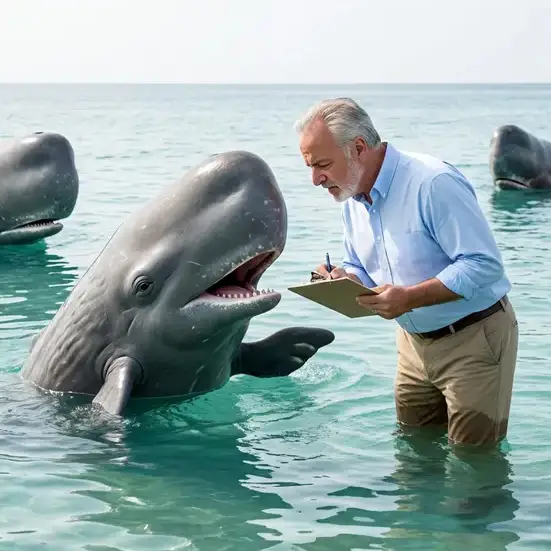
Dave: I will swim into a shipping container. I will do it.
Gary: [resurfacing nearby, quieter now, reflective]
I’m just saying. Of all the things they could have called us.
Phil: [softly] Yeah, buddy.
Gary: Blue whale gets to be BLUE. Humpback gets a POSTURE. Orca just gets to be ORCA, which sounds like a WARRIOR.
Phil: It does sound like a warrior.
Gary: And I’m just. SIgh. Sperm.
Dave: [very quiet i-coda]
Gary: [sinks approximately forty feet in silence]
What This Means for Gary, Specifically
Mason Youngblood, a researcher at Stony Brook University who studies songbird and whale communication, was unambiguous: these sounds are conveying more information than we previously understood, and that, he said, is “undeniable.”
This is genuinely exciting science. It’s also, if we’re being honest, mostly exciting because it means Gary has been delivering coherent, vowel-structured arguments about his name for potentially his entire adult life, and we have only now developed the tools to register that something meaningful is happening. He is not random. He is not noise. Gary is a large marine mammal with a legitimate grievance and the linguistic architecture to express it, and one day, when Project CETI finally cracks the full code of sperm whale communication, the first complete translation is almost certainly going to be Gary asking why, of all the words in the human language, they had to pick that one.
The second translation will be Phil saying something about the hagfish.
Nobody ever thanks the hagfish.

See my Amazon author page and buy my books.
His first manuscript was composed entirely of punctuation marks and confused sketches. He's since published "Not Bukowski" (poems that don't rhyme) and "Slop and Swell from a Festering Mind" (essays so concerning that bookstores check on his well-being). He once spent three hours photographing a rare bird that turned out to be a plastic bag, and he's the only person banned from church bake sales for "weaponized brownies." Inheriting absurdism from Vonnegut and Adams, sprawling narratives from Irving, and weaponized failure from Moore, he writes about conflicted everymen struggling through supernatural chaos.
He has two new, offbeat novels waiting for an agent or a publisher: "Truth Tastes Like Pennies" and "Elliot Nessie."
He remains unconvinced that birds aren't surveillance drones.
More biographic lies...err...info.
- KUMQUAT: A Sleep Study - May 8, 2026
- They Named Everything Firefly - May 7, 2026
- Marrakech v. America - May 5, 2026