Estimated reading time: 11 minutes
What a Victorian naturalist with a stuffed prop and zero chill figured out about your brain that Silicon Valley monetized into an existential crisis
The Father of Evolution Was Basically a Zookeeper Prank Channel
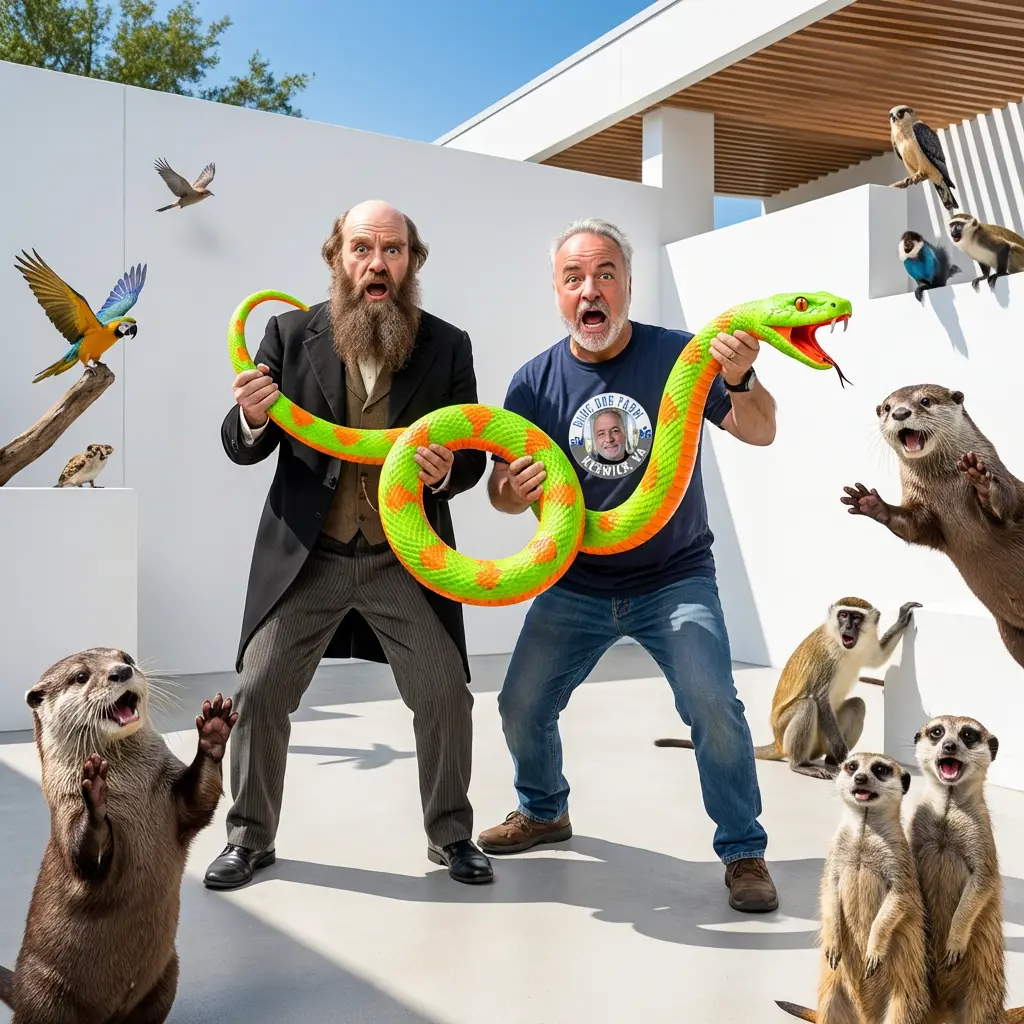
In 1838, Charles Darwin snuck up on a puff adder at the London Zoo with his face pressed against the glass, absolutely certain he could resist flinching. This was a man who had circumnavigated the globe, survived storms that would make a cruise ship passenger weep into their unlimited buffet, and was currently in the middle of rearranging humanity’s understanding of its own existence. He had, at this point, a fairly high opinion of his own composure.
He was also, at this particular moment, deep in research on cutis anserina. Goose bumps. The vestigial ghost of a threat response so ancient it predates our species by an embarrassing margin. When something scares you, the arrector pili muscles fire, the hair stands up, the skin puckers, and you briefly look slightly larger to whatever is trying to eat you. It doesn’t work anymore. We’re not hairy enough. The whole system is a biological Windows 95 running on meat hardware that your body never got around to uninstalling because, in certain key respects, your body is a disaster with good PR.
Darwin was contemplating all of this when the snake struck. He leaped backward like a man who had sat directly onto a running blender. He wrote about it in his notes with what can only be described as the glee of a man who has just proven something deeply unflattering about himself and found the data far more interesting than his dignity. Which, for Darwin, was always the correct call.
He went back the next day with a fake snake.
Let that settle. The man who would eventually be placed on British currency, gazed upon reverently in biology classrooms across the developed world, and name-dropped by every sophomore who just discovered that God is, like, a construct, spent his Tuesday afternoon sneaking around the London Zoo with a craft-store prop trying to make a mongoose have a cardiac event. Not as a joke. As science. Peer-reviewed, published, contributed to the canon of science.
It worked. Every time. The puff adder. The monkeys. The meerkats. Every single one. The brain registered a snake-shaped object, consulted zero additional sources, skipped the part where it thinks, and immediately issued a full-body emergency correction to the entire spine. No verification. No second opinion. Just raw, ancient, humiliating panic, delivered express.
Darwin wrote this down and called it science. He was completely right. He was also a grown man in a top hat doing a bit to a mongoose, and we should chisel that onto his monument and make it the first thing children learn.
The Darwin They Laundered for the Classroom
The version of Charles Darwin most people carry around in their heads arrived pre-sanitized, like a hospital gift shop version of a human being. Beard. Finches. Survival of the fittest, which he didn’t actually say. That phrase was coined by Herbert Spencer, a man history has correctly filed under N for Nobody Asked and left there. A figure of grave, epoch-defining seriousness who sat in a mahogany study thinking large, important thoughts until the thoughts became a book that broke the nineteenth century in half like a cracker.
This is an adequate summary of his legacy. It also describes a person who sounds extraordinarily boring and would be no fun whatsoever at a zoo.
The actual Darwin rode his children around on a giant tortoise, which raises several questions, none of which have bad answers, and at least one of which would make an incredible liability waiver. He maintained a lifelong list of every animal he had eaten, which grew over the decades into something between a scientific log and a cry for help. It included armadillo, puma, and a brown owl he described in his own words as “indescribably bad,” which implies he ate it anyway, which he did. He once ate a bird so rare it was previously unknown to science. He was halfway through it when he figured that out. At least, he salvaged the remaining bones for study and moved on, which is either the most Darwinian thing that has ever happened or the origin story of a man with absolutely no relationship to the concept of sunk costs.
He was tender, funny, obsessive, frequently ridiculous, and constitutionally incapable of encountering something interesting without immediately trying to eat it, sit on it, or scare it with a prop. The man contained multitudes. Most of them were feral.
Here is the thing about that. The willingness to crouch behind a shrub at the London Zoo with a stuffed snake and the willingness to spend twenty years on a theory before showing it to anyone were not separate qualities in some kind of charming contradiction. They were the exact same quality. Reckless, undignified, I-will-eat-that-owl curiosity. The thing that made Darwin great was the thing that made him a weirdo. The seams between those two things do not exist.
We decided that was inconvenient. The beard was kept. We put the marble bust in the classroom and told students: This is what genius looks like. Composed. Serious. Capital-I Important. Definitely not pressing his face against glass at the meerkat enclosure to see if he can make them faint with a prop from a hobby shop.
No wonder science has an image problem. We have been advertising the wrong product for 150 years.
Someone Took Better Notes
Here is what Darwin actually proved, in the zoo, with his prop and his notebook and his total absence of self-consciousness:
You do not need a real snake. You need a snake-shaped thing, delivered at the right angle, to the right cluster of neurons, faster than conscious thought can locate its car keys. The threat assessment happens below the floor of awareness, in a part of your brain so old it was running security for your ancestors before your ancestors had the decency to walk upright. By the time your conscious mind shows up to the situation, your body has already voted, drafted a press release, forwarded it to your adrenal glands, and begun catastrophizing. Your prefrontal cortex, the part that theoretically makes you a rational agent, is the last to know. It always is.
Fear is the fastest thing the brain does. Which makes it, consequently, the cheapest thing to trigger. A convincing snake shape costs nothing. An actual snake involves permits, overhead, and a non-trivial chance that your proof of concept eats your researcher.
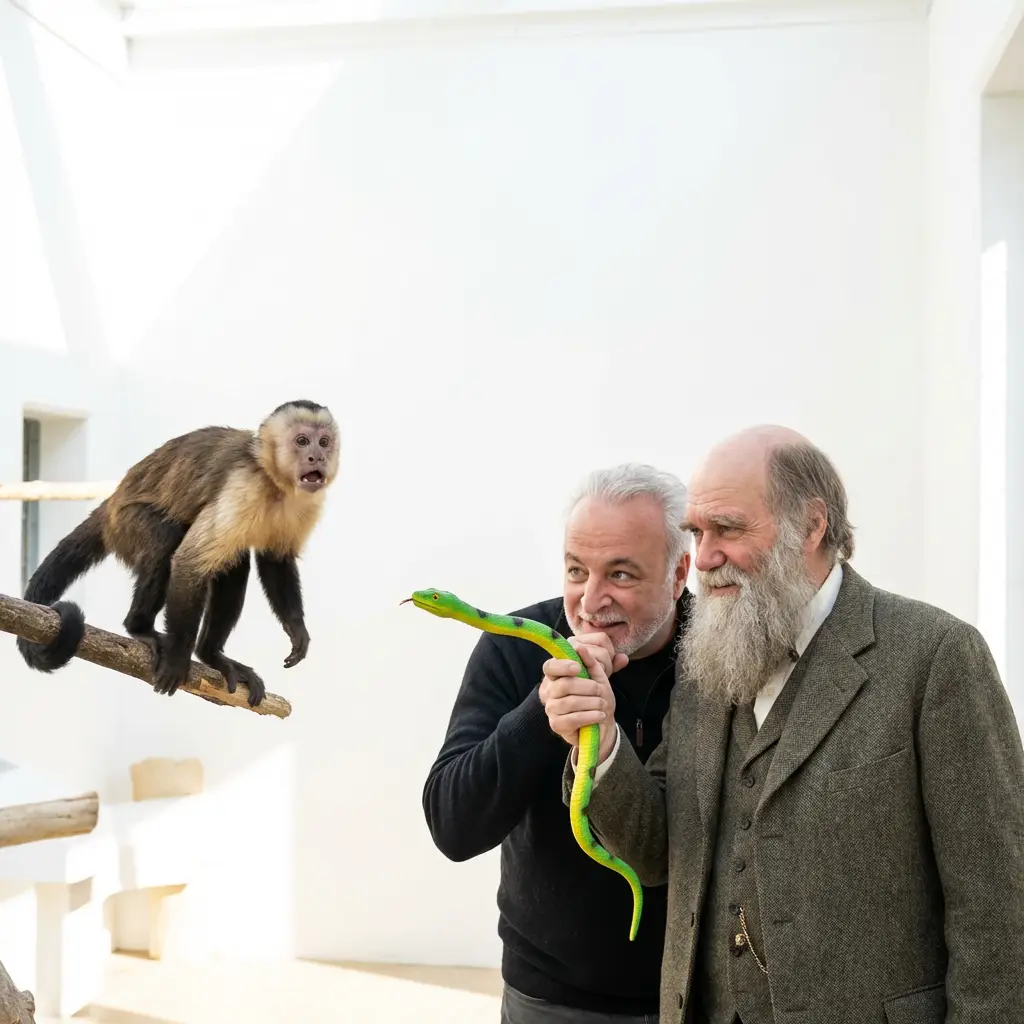
Darwin clocked all of this, wrote it up with evident delight, and moved on to the next thing that needed eating or terrifying. He was not thinking about monetization. It would not have occurred to him to think about monetization. He was thinking about what it meant that the arrector pili muscles were still there, still firing, still producing goose bumps on an animal that had long since lost enough body hair to make goose bumps useful. Vestigial. Magnificent. A fossil of ancient fear, still twitching in the bodies of creatures who now use them mostly to demonstrate that they found a good song.
Completely. Hijackable.
Goose Bumps as a Service
He didn’t think about the hijacking. That came later. That came from people who looked at Darwin’s notes and saw not a meditation on evolutionary residue but a gap in the market. People who wore fleece in a specific way that communicated both wealth and the performance of not caring about wealth. People whose relationship to human psychology was essentially the same as Darwin’s, except Darwin wanted to understand it, and they wanted to charge a CPM for it.
The attention economy did not invent fear as a product. It identified that Darwin had already run the proof of concept and left the patent sitting there like an unlocked car in a bad neighborhood. Every push notification engineered to feel like a fire alarm. Every headline built to pattern-match to existential threat before the reading-comprehension part of your brain can even load. Each algorithm tuned with monastic patience to find the specific snake-shaped thing that makes you specifically go full meerkat, refined across thousands of micro-exposures until it can trigger a complete cutis anserina response from across a room with four words and a stock photo of someone looking concerned.
The meerkats at least got to see it coming.
You get a notification about something that may or may not affect someone you have never met, in a place you will never go, involving a development that has not meaningfully changed since the last seventeen times you checked, served to you at the precise neurological moment your resistance is lowest, by a system that profits from the transaction regardless of whether anything you just felt was warranted. Real snake. Rubber snake. The hardware does not check. The hardware has never checked. That hardware was not built for checking. It was built for surviving, and it is very bad at surviving things it was not designed for, which now includes the entire internet.
You keep scrolling. That was always the point. Which was the point before the first line of code was ever written. Which was the point when someone in a four-hundred-dollar hoodie looked at a Victorian naturalist scaring zoo animals with a prop and thought, with the calm focus of something that eats other things for a living: what if we did that but everywhere, forever, to everyone, and we kept the money.
Somewhere in the gap between the snake-shape and the goose bumps, a very small amount of money changes hands. Multiply by four billion. Do not carry anything. That is the number. You have just reverse-engineered the twenty-first century from a Tuesday at the zoo in 1838.
The Fittest, Refreshing
Natural selection, as Darwin actually laid it out, is not about strength. It is not about dominance, or volume, or who gets the most engagement. It is about fit. About which organisms are most accurately calibrated to their actual environment. Which ones correctly identify threats? Which ones conserve energy rather than spending it screaming at things that will not eat them? Can one can tell the snake from the prop?
This is the theory we put on the currency of the country that invented the algorithm.
What we built instead is a system specifically engineered to make your threat responses fire on non-threats, keep your nervous system in a state of low-grade activation that presents as alertness and functions as slow damage, and ensure that you become a world-class expert in dangers you will never personally encounter while remaining completely oblivious to the ones that are, right now, in your house. You are not adapting to your environment. You are adapting to a simulation of an environment designed by engineers who understood Darwin well enough to weaponize him and cared about your well-being approximately as much as Darwin cared about that owl.
Natural selection does not favor organisms that spend six hours a day experiencing secondhand emergencies about strangers. Natural selection has been standing outside the door for about fifteen years now, and it has not come to make friends.
Your Hair Is Still Standing Up
Darwin understood something about animals that the attention economy understood about us: the ancient survival machinery is not smart. It was never supposed to be smart. Smart is slow and slow gets eaten. The machinery is fast. It was built to be fast. A brain that stopped to fact-check the snake would occasionally become a meal, so the brain does not stop. It does not check. It sees the shape, it fires, it moves. Darwin made it fire with a stuffed prop and found the whole thing so funny and interesting and perfectly horrible that he wrote four pages of ecstatic notes and went looking for something to eat.
We made it fire with a push notification about something a politician said, refined the delivery mechanism until it was happening before you were fully awake in the morning, then called it keeping you informed, and then rang a bell on Wall Street about it.
The supreme irony here, the thing that is either very funny or very dark or, more likely, both at the same time, wearing the same coat, is that we built the most sophisticated fake-snake delivery apparatus in the history of the species and marketed it as community. A connection. As the great democratization of information. As engagement, a word that is used to describe something a person chooses to do with their full attention, and now describes what happens to you while you are trying to look at a photograph of a dog.
What we built is a cutis anserina engine. Goose bumps as a service. Those arrector pili muscles, the ones Darwin was so charmed by, the ones that have been firing uselessly since before we were technically human, firing and firing and firing for rubber snake after rubber snake until the baseline and the alarm become the same tone, until you can no longer tell the difference between dread and just being awake, until you are a nervous system in a chair doing the one thing the architecture of the entire system was built to make you do.
Refreshing.
Darwin crouched in the bushes at the London Zoo with a stuffed prop because he was recklessly, joyfully, owl-eatingly curious about what the body knows that the mind doesn’t. He wanted to find the seams. He wanted to see exactly where the real thing ended, and the convincing facsimile began, and what that gap revealed about the long, embarrassing slog of being an animal that thinks it is something else.
Then, he published what he found. He ate things that should not be eaten. He died a hero.
The men in the fleece vests also wanted to find the seams.
The difference is that Darwin found them and wrote a book. They found them and built a box, and then they put you in it, and then they sold ads against you, and then they testified before Congress that they didn’t fully understand how any of it worked, which is the one thing they have ever said that might actually be true.
You’re still in the box.
The snake is still fake.
Your hair is still standing up.

See my Amazon author page and buy my books.
His first manuscript was composed entirely of punctuation marks and confused sketches. He's since published "Not Bukowski" (poems that don't rhyme) and "Slop and Swell from a Festering Mind" (essays so concerning that bookstores check on his wellbeing). He once spent three hours photographing a rare bird that turned out to be a plastic bag, and he's the only person banned from church bake sales for "weaponized brownies." Inheriting absurdism from Vonnegut and Adams, sprawling narratives from Irving, and weaponized failure from Moore, he writes about conflicted everymen struggling through supernatural chaos.
He has two new, offbeat novels waiting foran agent or a publisher: "Truth Tastes Like Pennies" and "Elliot Nessie."
He remains unconvinced that birds aren't surveillance drones.
More biographic lies...err...info.
- Packing for Marrakech, Distracted by Fried Chicken Fashion - April 20, 2026
- I Am Not a Carwash Guy Either - April 17, 2026
- Scientists Confirm Sperm Whales Have Language. Gary is pleased. - April 16, 2026


