Estimated reading time: 11 minutes
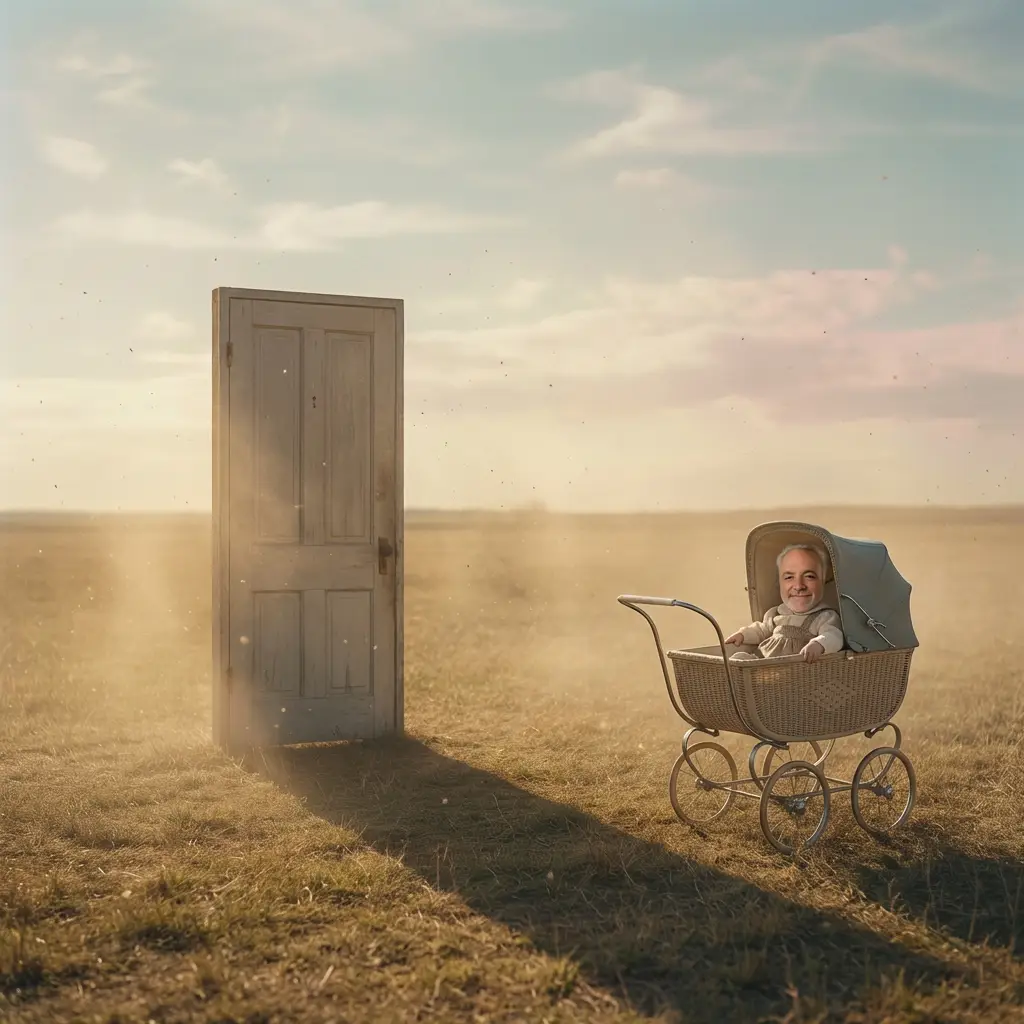
I want to start by clarifying something: my parents did not call me last night. They did not materialize at the foot of my bed in gossamer robes, trailing the soft light of eternity and the faint smell of whatever they are serving on the other side. They told me, while alive, in the way normal parents tell normal children mildly interesting stories that the child will later use as the entire foundation of their personality because therapy is expensive and mythology is free. My first word was “door.”
Not “mama.” Not “dada.” Not even something aspirational like “freedom” or “please” or “why.” Door. A rectangle with a hinge. The most aggressively unremarkable architectural feature in the history of human shelter, narrowly beating “adequate load-bearing wall” and “functional gutter drainage” in the race for words a baby should probably not be leading with.
And yet. Here I am, staring down the barrel of sixty, clutching this single syllable like it is a map and I have been waiting my entire life for someone to tell me what continent I am on. If you have ever wondered how a person ends up writing essays about doors on a farm in rural Virginia, well. Here is your answer. It started with a bassinet and a rectangle.
The Bassinet Lie I Have Told Myself for Decades
Here is something science will tell you, probably while adjusting its glasses and sighing the sigh of someone who has had this conversation before: you cannot remember anything before the age of four. The brain, that gelatinous narcissist floating in your skull, simply does not have the hardware installed yet to form long-term autobiographical memories in infancy. The hippocampus is still in beta. The prefrontal cortex has not shipped. You are, neurologically speaking, a very loud, very opinionated sweet potato with no capacity for long-term data retention and a suspiciously strong opinion about being put down for a nap.
And yet I have a memory. A vivid, sensory, emotionally textured, utterly convincing memory of lying in a bassinet, raising one fat and utterly useless baby finger toward a door, and saying “door” with the calm authority of a man who has just solved something. I can practically feel the weight of the blanket. I can see the light coming through at a particular angle. I can sense the deep satisfaction of having correctly identified a rectangle.
This memory is, of course, completely fabricated. My brain heard the story enough times and helpfully illustrated it, the way a contractor will build exactly what you asked for even if what you asked for is structurally nonsensical and you should not have asked for it. Neuroscientists call this “source monitoring error.” I call it “the brain is a con artist who has been gaslighting me since 1973 and has never once apologized.”
The truly horrifying part is that I cannot unlearn it. I know the memory is fake. I know this with the same certainty I know the earth is round and the Bills will find a way to lose. And yet the memory remains, fully rendered, comfortable as a lie that has been told so many times it has developed its own credit history.
(For more on the brain’s spectacular unreliability, feel free to revisit my essay on the attention economy and what Darwin would have thought of your phone, wherein I argue that natural selection has been actively working against us since the invention of the notification badge, and that the brain’s current survival strategy appears to be “scroll faster and retain nothing.”)
The Leap Year Loophole Nobody Is Talking About
Does the four-year memory threshold apply to Leap Year babies?
This is not a rhetorical question. I am genuinely furious that developmental psychology has not addressed it with the urgency it deserves, which is considerable. A child born on February 29th experiences a calendar birthday once every four years. By strict numerical accounting, they do not turn four until they are sixteen years old. So either the science tracks calendar birthdays, in which case Leap Year babies are operating under toddler brain architecture well into high school, which honestly explains a lot of people I went to high school with, or the science tracks actual elapsed time, in which case the entire field of developmental psychology is using sloppy language and should be more careful, and also possibly should return some grant money.
I have no resolution to offer. I just think if you were born on February 29th and you remember your bassinet with the clarity of a documentary film, you have a very strong legal case against someone, and a Leap Year attorney somewhere in Ohio is getting rich off exactly this, and good for them. If you are that attorney, I would like to retain you.
Thirty Moves and the Architecture of Impermanence
I have moved more than thirty times in my life. Thirty. As a point of reference, the average American moves about eleven times in their entire lifetime, a statistic I have lapped twice with the energy of a golden retriever and the judgment of a man who has never once asked himself “but why, though.” I have lived in apartments with mold that had more personality than the landlord. I have lived in houses where the previous tenant left behind a single motivational poster and a sense of profound unease. On at least two occasions, I have moved into a place and immediately begun wondering how I was going to get out of it, which is either a character flaw or excellent editorial instincts, and I choose to believe the latter.
My wife Karie and I now live on a farm outside Charlottesville, Virginia, with a pig named Trouble McFussbucket and a chihuahua named Señor Hector “Queso” Suarez DDS, who arrived as a foster dog, which is the universe’s way of saying “you are not as in control of your life as you believe,” and who has also never moved once and appears substantially more psychologically stable than I am. Queso has one address, a warm blanket, and the energy of someone who has achieved enlightenment and would like you to stop blocking the sun. He did not say “door” as his first word. He said nothing, because he is a dog, and he has been right about everything ever since.
Thirty moves means thirty sets of door frames. Thirty thresholds. Those thirty moments of standing in an empty room that still smells faintly like the previous version of your life, looking at the door you are about to walk out of, trying to do the math on whether any of it adds up to anything, and then concluding that it does not, probably, but you are going to pack the dishes anyway. I have written about this particular flavor of productive denial before, and the conclusion is always the same: the dishes survive. The landlord keeps the deposit. Life continues.
Doors, it turns out, are the punctuation marks of a transient life. Every move is a sentence. Every door is a period. I have written thirty sentences and I am still not entirely sure what the paragraph is about, but I am told the important thing is that I kept writing.
This might explain the first word. Not in any mystical sense. Not because the universe was foreshadowing, the way a novelist plants a motif in chapter one so that the reader feels the satisfying click of recognition in chapter twenty-two. But because perhaps, in some deeply unpoetic way, I have been a door person from the very beginning, and my infant brain, which could not yet say “I have an anxious attachment to impermanence and a long history of treating zip codes like suggestions,” said the next best thing.
It said: door.
Honestly? Nailed it.
Famous Doors That Carried the Weight of History (and Some That Absolutely Did Not)
Doors have been doing heavy lifting throughout recorded civilization, which is remarkable for something that technically just sits there and waits. Here is an incomplete and largely editorialized survey.
The Doors of Perception. Aldous Huxley wrote about them in 1954, borrowing the phrase from William Blake, who had previously written that if the doors of perception were cleansed, everything would appear to man as it is, infinite. Jim Morrison read this, was very moved, named his band after it, wrote some songs, took some substances, and eventually died in a bathtub in Paris at twenty-seven, which is proof that some doors, when opened, lead directly to a bathtub in Paris, and someone should have put a sign on them. A laminated sign. Possibly with a warning graphic.
The Door on the Titanic. There was allegedly enough room on that floating door for two people. This is the most passionately argued architectural debate in the history of cinema, surpassing whether the Death Star needed an exhaust port and whether the balcony in Romeo and Juliet was up to code. Rose chose to survive. Jack chose to be a cautionary tale about the consequences of door-sharing negotiations conducted in hypothermic conditions. The door itself had no opinion, because it was a door, and doors do not negotiate. This is one of their best qualities.
The Door Franz Kafka Never Got Through. In The Trial, a man spends his entire life waiting to pass through a door that was, it turns out, built specifically for him, designated exclusively for his use, and which he was always free to enter at any time. He discovers this as he is dying. Kafka apparently thought this was hilarious. Kafka was, by all available accounts, not a person you would want to have brunch with, but he understood doors better than most, and also bureaucracy, and also the unique terror of a morning where nothing is technically wrong but everything feels like it is about to be.
The Door Richard Nixon’s Guys Taped Open. The Watergate break-in was possible because a security guard noticed tape left on a door latch and reported it. The entire trajectory of American political cynicism, the total collapse of institutional trust that has been compounding with interest for fifty years, traces back to a piece of masking tape on a door in Washington in 1972. My first word has caused actual historical events. I am choosing to take some credit for this. You are welcome, history.
The Door to Room 237. Jack Nicholson’s character in The Shining spent considerable time, energy, and ultimately an axe trying to get through a door, which, in retrospect, should have been the moment the film crew intervened. The door eventually let him through. It should not have. Sometimes “door” is not an invitation. Sometimes “door” is the universe’s way of saying “the answer to what is behind here is worse than the question, and you have a perfectly good lobby, please go sit in it.” This is also good life advice. I am still working on following it.
The Door No One Mentions: Every Airport Gate That Closes Thirty Seconds Before You Get There. This door has caused more genuine human anguish than Kafka, Huxley, and the Titanic combined. It closes with the calm indifference of something that has seen everything and feels nothing. It will destroy your afternoon. It will make you reassess every decision you made in the past forty-eight hours. It is the purest door. That is the door I respect most. I have written about the specific grief of missed connections before, and the airport gate is the platonic ideal of the type.
What the Door Actually Means, If We Are Being Honest, Which We Might As Well Be Since I Am Almost Sixty
I do not think the door thing is cosmic. I do not think the universe planted a single syllable in my infant mouth as a breadcrumb toward some greater spiritual truth I was meant to spend six decades following. And, I think it is, more likely, the first interesting-shaped object my potato brain could perceive and name, because doors are large, rectangular, and tend to move. If you are nine months old and your previous entertainment was a ceiling fan, a door is essentially a blockbuster film.
But thirty moves give you a relationship with doors that most people do not develop, and probably should not. You learn to read them the way a sommelier reads wine, and with roughly the same amount of pretension.
Hollow-core doors mean the landlord does not respect you and has probably also not replaced the water heater since 1987. Solid wood doors mean either you have arrived or you are in an old house and everything is about to start squeaking in a way that will teach you more about your own stress responses than you wanted to know.
Sliding glass doors mean California, or heartbreak, or a California heartbreak, which is its own specific subcategory with its own soundtrack and its own particularly optimistic brand of denial.
Screen doors mean a porch and someone’s grandmother and sweet tea and the very real possibility that someone is going to offer you a piece of pie, and you should accept it, because the pie is real and the door is temporary and you will miss the pie long after you have forgotten the door.
Every door I have walked through has been a small, mostly unconscious decision about who I was going to be on the other side. Most of them I cannot remember, which the neuroscientists assure me is completely normal and also somewhat merciful. The brain, that magnificent fraud, keeps only what it finds interesting and quietly discards the rest. It’s like an editor with no respect for your word count and a particularly aggressive delete key.
I find it equal parts poetic and personally insulting that the one door I claim to remember is the one I definitively cannot.
But I said the word. Somebody heard it. They wrote it down somewhere in the parenthetical mythology of a family that no longer exists in the way it used to. Then, passed it to me like a smooth stone you carry in your pocket for years, no longer entirely sure how it got there, not quite ready to put it down.
Door.
Open it or don’t. You are going to move thirty more times anyway, and Queso is not helping you pack.

See my Amazon author page and buy my books.
His first manuscript was composed entirely of punctuation marks and confused sketches. He's since published "Not Bukowski" (poems that don't rhyme) and "Slop and Swell from a Festering Mind" (essays so concerning that bookstores check on his wellbeing). He once spent three hours photographing a rare bird that turned out to be a plastic bag, and he's the only person banned from church bake sales for "weaponized brownies." Inheriting absurdism from Vonnegut and Adams, sprawling narratives from Irving, and weaponized failure from Moore, he writes about conflicted everymen struggling through supernatural chaos.
He has two new, offbeat novels waiting foran agent or a publisher: "Truth Tastes Like Pennies" and "Elliot Nessie."
He remains unconvinced that birds aren't surveillance drones.
More biographic lies...err...info.
- Packing for Marrakech, Distracted by Fried Chicken Fashion - April 20, 2026
- I Am Not a Carwash Guy Either - April 17, 2026
- Scientists Confirm Sperm Whales Have Language. Gary is pleased. - April 16, 2026