Estimated reading time: 7 minutes
America returned to the moon on April 1st. This should tell you everything you need to know.
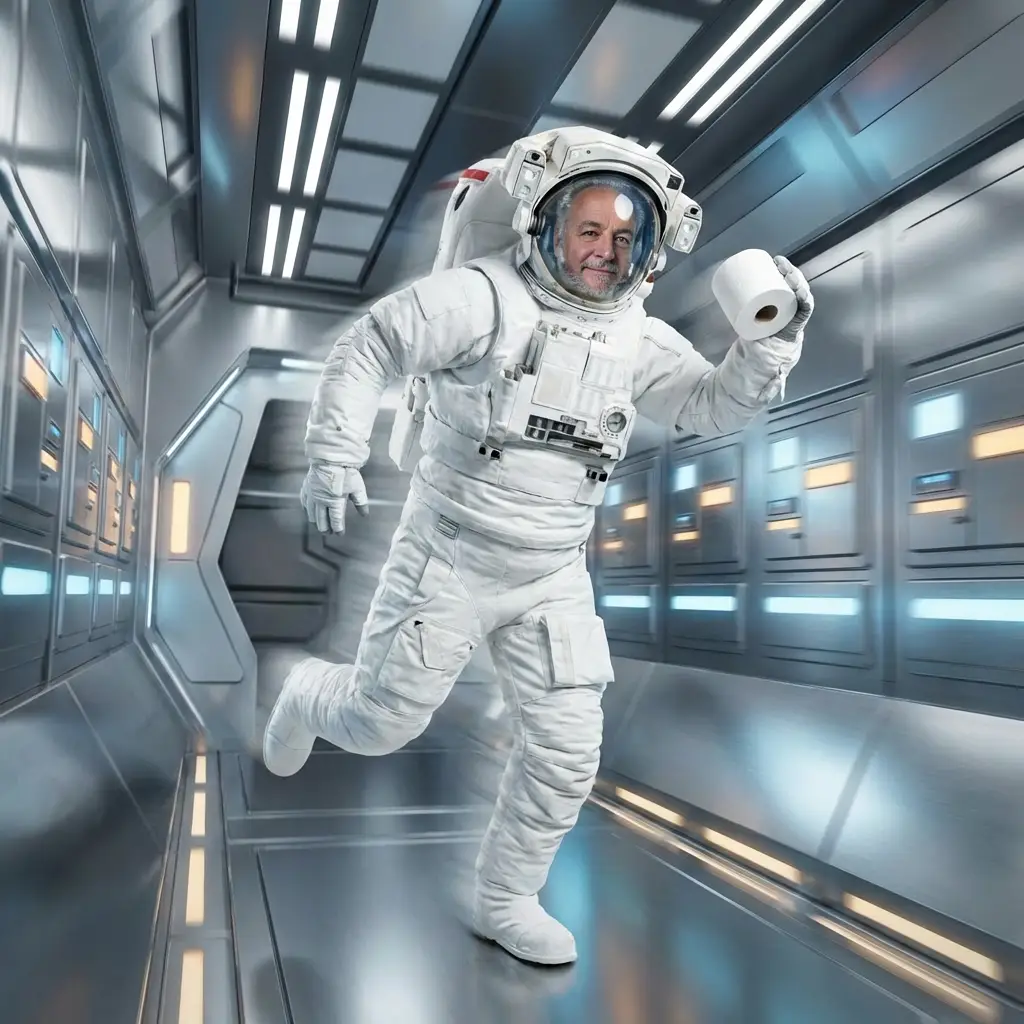
After more than five decades of waiting, after billions of dollars and countless political administrations and the genuine accumulated engineering genius of thousands of NASA scientists, we launched four human beings toward the lunar surface on April Fools’ Day, 2026. The rocket cleared the launchpad at Kennedy Space Center in a column of fire and thunder. The crowd cheered. History trembled. Schoolchildren watched from gymnasiums across the nation. And roughly six hours later, the toilet broke.
Not metaphorically. The actual toilet. The urine portion, specifically.
This is the story of America’s grand return to deep space, and it smells exactly like you think it does.
Houston, We Have a Different Kind of Problem
To appreciate the full absurdity here, you have to understand what NASA calls the toilet. They do not call it the toilet. They call it the Universal Waste Management System, or UWMS, which sounds like what a cash-strapped county government names its sanitation department when it’s trying to get a bond measure passed. The UWMS is a 3D-printed titanium marvel that took a decade to engineer, costs more than your neighborhood, and broke before the crew finished their first cup of freeze-dried coffee.
The malfunction, NASA explained in its characteristically composed and bureaucratically serene way, involved a “blinking fault light” related to the toilet’s fan system. In space toilets, the fan isn’t just there for ambiance, or to drown out embarrassing sounds, or to give the illusion of dignity in a 330-cubic-foot capsule. In zero gravity, airflow is what pulls waste toward the toilet rather than away from it. This distinction becomes fairly critical when you are hurtling through the vacuum of space at 17,000 miles per hour with nowhere to go and three colleagues who will never, ever let you forget it.
Mission specialist Christina Koch, the only woman aboard and apparently the one with the most situational awareness, was first to notice the blinking light and report it to mission control. The fan was jammed. The urine collection system was down. The crew was instructed to use the backup system.
The backup system was bags.
Congratulations, America. We’re back.
We Went to the Moon and Left Our Garbage There
Here is what the Apollo astronauts used for a bathroom: plastic bags, taped to their bodies, in a cramped capsule, for days at a time. NASA’s own internal report after the Apollo program described this experience as “objectionable” and “distasteful,” which is the kind of antiseptic understatement that makes you realize why scientists should never be allowed to write Yelp reviews. These were men who rode controlled explosions into space, walked on the surface of another world, and planted the American flag in the lunar soil. The bags were still the worst part.
When the lunar lander touched down and astronauts actually set foot on the surface, they brought the bags with them, because of course they did, because the bags were always with them, the bags were life now. Then, to reduce weight for the return trip home, NASA made the decision to leave the waste behind. They just left it there. On the moon.
Ninety-six bags of human excrement are currently sitting on the surface of the moon. They have been there since 1969. They will be there long after every one of us is gone, after our own waste has returned to the earth, after the last person who remembers what a moon landing felt like has turned to dust. Somewhere up there, in the stillness and the radiation and the silence, are bags of astronaut feces that are older than most sitting heads of state.
We planted a flag. We left our garbage. Classic Americans.
There is, improbably, a scientific argument for going back to get them. Microbiologists have pointed out that the bags represent a genuinely fascinating experiment: can microorganisms survive decades of lunar radiation and temperature extremes in a sealed bag? Are there still living bacteria up there, frozen mid-metabolic-process, awaiting collection and study? And, perhaps more pressingly, is there corn? Corn, famously, sends its outer hull through the human digestive system essentially unscathed, which means the 96 bags currently sitting on the lunar surface almost certainly contain identifiable kernel shells, which means corn has technically been on the moon since 1969 and has received absolutely none of the credit. Neil Armstrong got a parade. The corn got a bag. This is a legitimate research question that has been published in legitimate scientific journals, and the methodology section begins, functionally, with the sentence “first, we retrieve the moon poop.”
The most famous single moment in the history of space toilet failure comes from Apollo 10, which I will reproduce here because it is one of the greatest sentences ever spoken into a radio by a federal employee: “Give me a napkin quick. There’s a turd floating through the air.”
That was 1969. We have spent 57 years and incalculable resources working on this problem, and also leaving evidence of it on other celestial bodies, and also, apparently, not entirely solving it.
The Fan That Held History Hostage
To be generous to NASA, and I say this as someone who finds government competence genuinely moving in the rare moments it surfaces, they fixed it. Mission control talked the crew through clearing the fan obstruction, the UWMS was coaxed back to full functionality, and Christina Koch closed out the first day by thanking ground teams for “an awesome first day,” displaying a level of grace under pressure that astronauts apparently manufacture in quantities unavailable to the rest of us.
NASA associate administrator Amit Kshatriya explained at a press conference that the problem was a “malfunctioning controller” in the toilet’s system. The toilet has a controller. The toilet is, in some meaningful sense, a computer. We built a space computer, printed it in titanium, installed it on a rocket ship bound for the moon, and the first thing it did was refuse to process urine. Somewhere a junior engineer is having a very specific kind of career day.
The UWMS is, per NASA, a “mission-critical system.” If it fails permanently, the mission is in jeopardy. Not the science. Not the orbit. The toilet. The entire enterprise of returning humanity to lunar space can be held hostage by a jammed fan in a bathroom the size of an airplane lavatory, which is also, not coincidentally, where you feel most like you might die.
And here is the final detail, the one that ties it all together, the bow on this particular gift: the toilet is so loud that the crew must wear ear protection while using it.
You need hearing protection to go to the bathroom in space. The most privately human moment available to a person floating 200 miles above the Earth, drifting toward the moon in the cosmic silence, a silence so profound it is itself a kind of religion, and it sounds like a leaf blower eating another leaf blower. Canadian astronaut Jeremy Hansen described the toilet as “the one place that we can go on our mission where we can feel like we’re alone for a moment.” He said this about a room you enter wearing earplugs, to use a machine that, until six hours into the mission, did not work.
Flush with Success (We’re So Sorry)
Future Artemis crews will fly to the moon with a fully functional toilet because four astronauts spent the first six hours of humanity’s grand return to deep space doing the pee pee dance. That is the legacy. That is what goes in the history books, right underneath the orbital mechanics and the heat shield specifications and the photograph of Earth rising over the lunar horizon. A footnote. A blinking fault light. A bag. And four of the most rigorously trained human beings on the planet, crossing their legs.
Meanwhile, the corn waits. Patient. Indigestible. Eternal. It was there before the UWMS. It will be there after. If there is ever a plaque on the moon that lists every species to have visited, the corn has a stronger claim than most.
And somewhere on the ground in Houston, a flight controller spent yesterday explaining to reporters, with a straight face, in front of cameras, that America’s return to the moon had been briefly complicated by a jammed toilet fan, and that everything was fine now, and that at least one astronaut had used a bag, and that the others had simply held it for six hours, hurtling through the void at 17,000 miles per hour, and that yes, the crew had been asked to wear earplugs, and that no, he would not be taking further questions.
To boldly go.

See my Amazon author page and buy my books.
His first manuscript was composed entirely of punctuation marks and confused sketches. He's since published "Not Bukowski" (poems that don't rhyme) and "Slop and Swell from a Festering Mind" (essays so concerning that bookstores check on his well-being). He once spent three hours photographing a rare bird that turned out to be a plastic bag, and he's the only person banned from church bake sales for "weaponized brownies." Inheriting absurdism from Vonnegut and Adams, sprawling narratives from Irving, and weaponized failure from Moore, he writes about conflicted everymen struggling through supernatural chaos.
He has two new, offbeat novels waiting for an agent or a publisher: "Truth Tastes Like Pennies" and "Elliot Nessie."
He remains unconvinced that birds aren't surveillance drones.
More biographic lies...err...info.
- Dear Brian: A Rejection Anthology - May 12, 2026
- KUMQUAT: A Sleep Study - May 8, 2026
- They Named Everything Firefly - May 7, 2026