Estimated reading time: 9 minutes
I was scrolling through Nextdoor on a Tuesday afternoon, which is already a low point in any week, looking for nothing in particular and finding, as one always does on Nextdoor, considerably more than that. There was a missing tortoiseshell cat named Persimmon, a passive-aggressive post about leaf blowers that had generated forty-seven comments, and a woman in Palmyra named Alicia V. who wanted to sell me my death.
Not in those words, exactly. Alicia is a real estate professional at heart, and real estate professionals do not deal in death. They deal in opportunity. Death is just the silent investor.
“Enjoy your final retirement,” the listing began, “at the beautiful and well maintained Monticello Memory Gardens in Charlottesville, Virginia.”
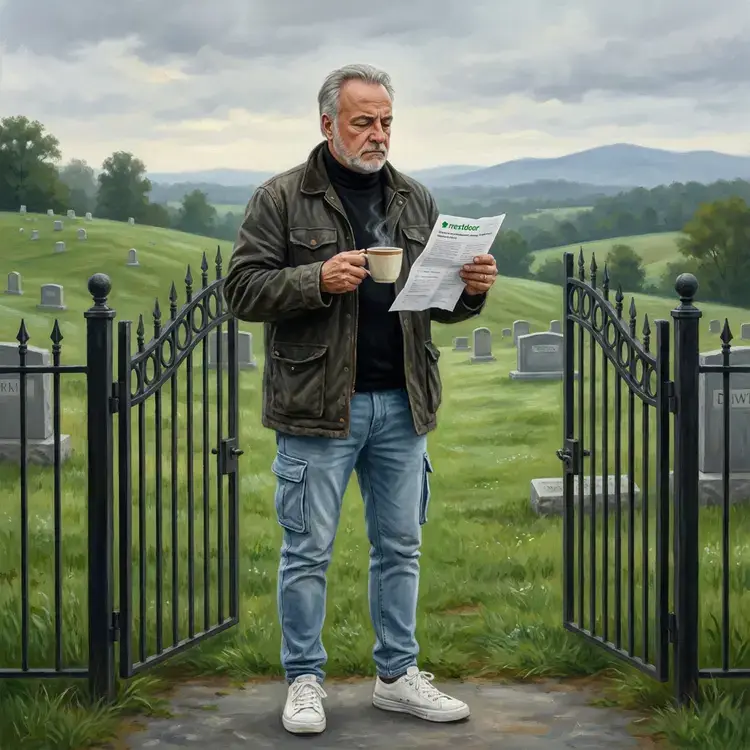
I put down my coffee. I picked it back up. I put it down again. This was going to require both hands and possibly a lawyer.
The listing is titled “2 plots for Cremains,” which stopped me before I even got to the pitch. Cremains. This is the funeral industry’s contribution to the English language, a portmanteau of “cremated remains” assembled by someone who apparently felt that neither word alone was doing enough heavy lifting. It sounds like a French pastry. It sounds like something you would order at a bakery in Lyon and receive on a small plate with a paper doily. Two cremains and a café au lait, s’il vous plaît. It sounds like a premium spreadable cheese, or possibly a skin care line for women of a certain age.
New Cremains. Because you’ve earned it.
The funeral industry has a long history of this kind of linguistic softening. We do not die, we “pass.” We are not buried, we are “interred.” We are not dead, we are “at rest,” which implies we were tired, which, frankly, by the end, we probably were. But “cremains” went in the opposite direction. Instead of softening the reality, someone fused two perfectly honest words into a single syllable cluster that sounds like an upscale brunch item and means something your family will carry out of a funeral home in a box the size of a shoebox. Language is doing its best.
Language is not always succeeding.
Location, Location, Cremation
The pitch was meticulous. Alicia had done her homework. The property (and she wants you to think of it as property, because property has value and value creates urgency and urgency overrides the part of your brain that is screaming) sits on what she calls “hallowed grounds between Carter’s Mountain and Monticello off of route 64 and 20.”
Thomas Jefferson’s estate is roughly two miles away. This is not incidental. This is the Jefferson Premium, and you are paying for it even if you will not, technically, be able to enjoy the view, discuss the architecture, or form any opinions whatsoever.
In American real estate, proximity to greatness is always monetized. You pay more to live near a good school even if you have no children. You pay more for a mountain view you will spend most of your time not looking at. And apparently you pay a significant markup to spend eternity in the general vicinity of a man who wrote that all men are created equal while personally owning six hundred of them. The neighborhood has complicated history. The HOA is probably a nightmare. The founding fathers are not what you would call easy neighbors.
This region has a long tradition of dissociating famous remains from any coherent narrative about them. A short drive from my farm, Stonewall Jackson’s arm is buried separately from the rest of Stonewall Jackson, who is in Lexington. The arm was lost at the Battle of Chancellorsville in 1863, was amputated, and was interred at Ellwood Manor, where it has been ever since, apparently at peace with the arrangement. My daughter and I once visited and took selfies with one arm hidden in our shirts, which felt like the correct response. The arm has no opinions about this. The arm is, of the two parties, handling it better.
The point is that around here, fragmented legacy is not a bug. It is a feature. You can be in multiple places at once. You can mean different things to different people. You can be a monument, a cautionary tale, and a selfie opportunity simultaneously. Alicia is simply offering you a place in that tradition, at below market value.
The Bargain of a Lifetime (and Beyond)
Here is where Alicia makes her strongest play: “Buy this prime real estate under market value now and never worry about real estate taxes again.”
I have read a lot of property listings. I have never read one that deployed “no property taxes” as a selling point and meant it with such complete and ruthless accuracy. Most listings imply you will be alive to appreciate the financial benefit. Alicia is not trafficking in implication. She is being honest in a way that most of us prefer to avoid before eleven in the morning, or indeed ever.
The market value, she notes, is $23,400. She is asking $12,500. That is a savings of $10,900, which you could apply toward, among other things, a very nice final dinner, a new guitar, a trip somewhere warm you will actually be able to experience, or roughly eleven hundred scratch tickets, any of which represents a more optimistic use of the funds.
“Would like to sell soon,” the listing concludes.
Why soon, Alicia?
Is the market softening? Is this a motivated seller situation? Did something happen that we should perhaps discuss before any money changes hands?
Here is my leading hypothesis: Alicia bought these plots with someone in mind and that someone is no longer in the picture. Not gone-gone (that would make the plots more necessary, not less). No. The someone moved to Phoenix. The someone remarried. The someone said, with the particular cruelty only the living can manage, “I don’t think I want to spend eternity next to you,” and now Alicia has two urns, a headstone, and a real estate problem.
Alternatively, and I find this more compelling, the cremains got lost. This happens more than the funeral industry would like you to know. People put urns in closets and move three times. People mean to scatter the ashes somewhere meaningful and run out of meaningful. People leave the remains on the back seat of a car and sell the car. The plots were purchased with great intention, the cremains were acquired, the cremains were temporarily placed somewhere sensible, and now nobody can remember where sensible was. The plots sit empty. The headstone waits. Somewhere in a storage unit outside Palmyra, in a box labeled MISC, two people are still together in the only way available to them, nestled between a broken treadmill and a box of Reader’s Digests from 1987, waiting to be found.
I do not ask these questions out loud because I know the answer is the same subtext beneath every real estate transaction: someone made a plan that no longer fits the life they are actually living. Someone has to liquidate the future they imagined. And they listed it on Nextdoor, between a sectional sofa and some free zucchini, because that is where unresolved plans go to find new owners.
The Inventory Problem
I am sixty years old, which means I have recently become the target demographic for this kind of listing whether I endorse the timeline or not.
My Doctor Renewed Me for Another YearMy doctor renewed me for another year at my last physical, which is how I have come to think of the annual review — a lease extension, a subscription renewal, a thumbs up from the building inspector who is being paid to find things structurally sound and has his own mortgage to think about. But the building is sixty years old now and nobody is pretending the foundation does not have opinions.
As you might already know, I live on a farm outside Charlottesville with my partner Karie, a pig named Trouble McFussbucket, a chihuahua named Señor Hector Queso Suarez DDS, a blind dog named Remmi, a cat named Vinny Van Meow, and a five-pound dog named Professor Archibald Pickles who appears to be constructed entirely of anxiety and static electricity. It is not a small household. It is, in fact, the exact opposite of two urns and a headstone on a quiet hillside near Monticello, which until Tuesday had not struck me as a contrast worth examining.
I have not purchased plots. I have not made arrangements. I have, to be fair, barely made dinner reservations. But Alicia’s listing landed in my feed at the precise moment in life when these things start to feel less theoretical, when the actuarial tables begin to feel like they are about you specifically rather than a statistical cohort you belong to through no fault of your own, when you start doing the math on what you will leave behind and whether “near Monticello” is a selling point for the people who will be visiting or primarily for you, and you will not be visiting. You will be the inventory.
What We Actually Mean When We Buy Property
The American relationship with real estate is, at its core, a relationship with permanence. We buy property because it stays. It is there when we are not. The house outlasts the mortgage, outlasts the marriage sometimes, outlasts the version of us who thought the open floor plan was a good idea. The deed goes in a drawer and means something even when we are gone, which we treat as a comfort and refuse to examine too closely.
A burial plot is just the final expression of this impulse. We want to be somewhere. We want coordinates. We want someone to be able to find us, even if finding us means standing in front of a headstone and talking to the general atmosphere while a groundskeeper mows at a respectful distance.
Alicia is not selling death. She is selling the same thing every real estate agent sells: the illusion that the right location solves the problem of impermanence. That if you choose well — if you get the good neighborhood, the southern exposure, the Jefferson adjacency — then the fact of ending is somehow less arbitrary, less indifferent, less like a thing that happens to everyone regardless of zip code or net worth or how many meaningful relationships you maintained.
It is a beautiful con. It is the most human con. I respect it in the way I respect all great cons: with a combination of admiration and the quiet awareness that I am exactly the target.
The Counter-Offer
I did not buy the plots. I thought about it longer than I probably should have, which tells you something about being sixty and living six miles from hallowed ground and having recently begun to find real estate listings for the afterlife surprisingly reasonable.
What I keep coming back to is the phrase that stopped me cold on a Tuesday afternoon with a cooling cup of coffee: never worry about real estate taxes again.
It is the most accidental wisdom in the history of Nextdoor, which is an extremely competitive category. It is the promise that every financial advisor, life coach, meditation app, and pharmaceutical commercial is trying to sell you in a thousand different ways and none of them with this level of follow-through. Somewhere on the other side of all this accumulation and anxiety and property management is a place where the worrying stops, and Alicia has found it and she will let it go for $12,500, which is frankly a steal considering what worry costs.
The listing is still up. The plots are still available. Two urns, a headstone, two openings and closings, and the eternal silence of the Virginia hills.
Alicia would like to sell soon.
Jefferson is right down the road.
I think we all know how this ends.

He once traded a MetroCard for a pitchfork on a subway platform and now uses it exclusively for dramatic pointing. He lives on a farm outside Charlottesville, Virginia with a partner who smiles politely at his life choices, a pig named Trouble McFussbucket who has opinions about the sofa, and a five-pound dog named Professor Archibald Pickles who appears to be held together entirely by anxiety and unearned confidence.
See his Amazon author page and buy his books before he spends the royalties on the pig.
Inheriting absurdism from Vonnegut and Adams and weaponized failure from Moore, he writes about conflicted everymen stumbling through supernatural chaos. He has published "Not Bukowski" and "Slop and Swill from a Festering Mind," and has two new novels seeking a publisher: "Truth Tastes Like Pennies" (available to paid Substack subscribers June 1) and "Elliot Nessie."
He remains unconvinced that birds aren't surveillance drones.
More biographical lies...err...info.
- Never Worry About Real Estate Taxes Again - May 13, 2026
- Dear Brian: A Rejection Anthology - May 12, 2026
- KUMQUAT: A Sleep Study - May 8, 2026