Estimated reading time: 7 minutes
(Here are the details of how I set about writing stories from vintage photos, like this one: “The Velocity Cult of 1896: How a Bicycle, a Chicken, and Terrifying Mascots Nearly Broke the Space-Time Continuum.“)
Why This Essay Exists (Spoiler: I Have No Idea What I’m Doing)
Let me be clear from the start: I have absolutely no formal credentials in teaching you how to do anything, least of all writing stories from vintage photos. What I do have is a collection of bizarre historical images that showed up in my life thanks to a fine gentleman I met in a bar named Matt, and a pathological inability to look at something weird without inventing an elaborate backstory involving dimensional portals and farm animals with supernatural powers.
This is the first in a three-part series where I’m going to pretend I know what I’m talking about while demonstrating how to construct an entire narrative universe from pictures of a guy with a bicycle, a child with a chicken, and some nightmare fuel involving oversized mascot heads. The “technique” I’m using, and I use that word so loosely it’s practically falling off, is to find the weirdest detail in each photo and ask myself: “What if this was the most important thing that ever happened?”
Spoiler alert: It wasn’t. But that’s never stopped me before. (If you want to read the story that evolved, it is here.)
The Genesis of Stupidity: Finding Your Weird Detail
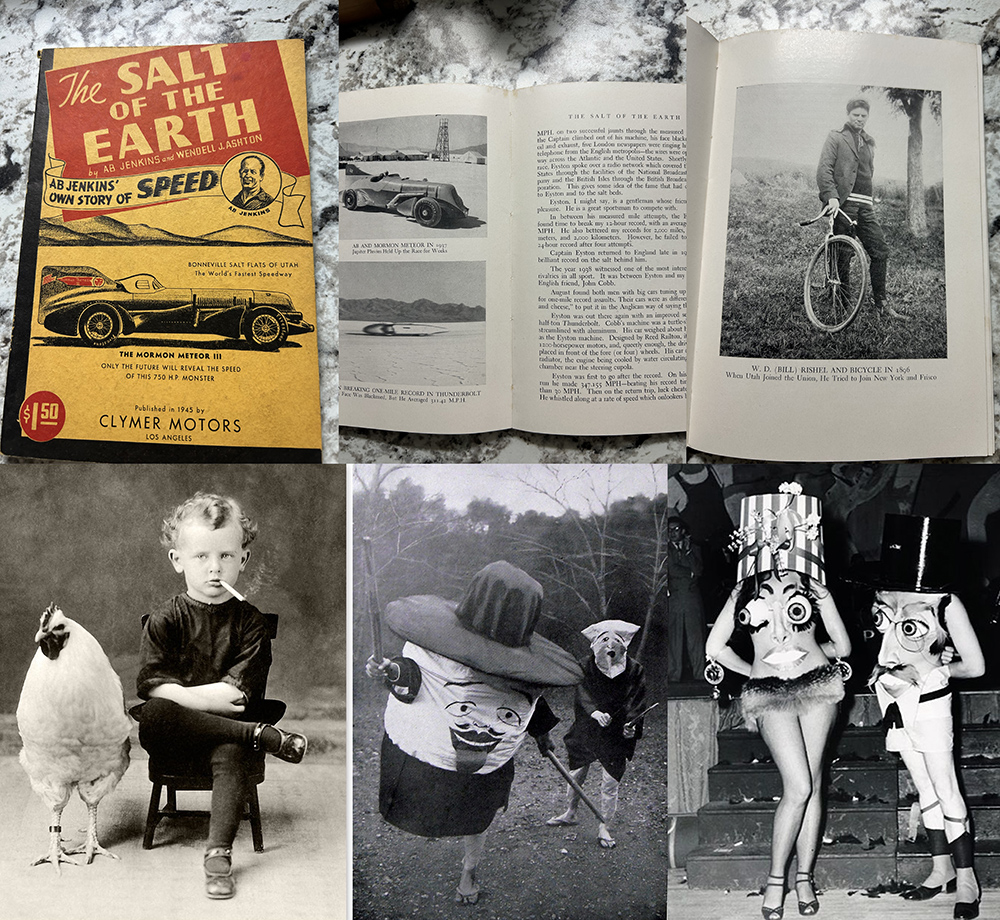
The first photo I encountered was of W.D. “Bill” Rishel standing with a bicycle in 1896, looking determined in that way people looked determined when photography required you to hold still for seventeen minutes or risk appearing as a ghostly blur. The caption read: “When Utah Joined the Union, He Tried to Join New York and Frisco.”
Now, a typical person would read this as “he tried to move to New York or San Francisco.” But I am not burdened with normalcy, so I read it as “he tried to exist in both places simultaneously through the power of bicycle-based teleportation.”
This is step one of writing stories from vintage photos: deliberately misunderstand everything. Take the most boring possible interpretation and throw it directly into the garbage. We’re not here for facts. We’re here for lies that are more interesting than the truth.
Building Your Absurd Universe: The Sacred Art of “What If?”
Once you’ve identified your weird detail, it’s time to build an entire cosmology around it. Bill wanted to bicycle to two places at once? Fine. Why? Because in my version of reality, he’d consumed fermented cactus juice at a church social and received a vision from the desert about restructuring spacetime through velocity.
Did this happen? Absolutely not. Does it make for better fiction than “man rode bicycle, was tired”? You’re goddamn right it does.
The key to writing stories from vintage photos is understanding that every old photograph is evidence of something, and you get to decide what that something is. That bland expression on Bill’s face? In reality, probably just “I’m tired of standing here while this photographer fiddles with his equipment.” In my version? “I have seen beyond the veil of reality, and the bicycle is my prophet.”
Characters Need Motivation (Even Ignorant Ones)
Here’s where we separate amateur photo-fiction from the good stuff: your characters need to want something, even if what they want is cosmically ridiculous. Bill doesn’t just want to ride his bike. He wants to break physics. He wants to achieve “bi-locational ambulation.” He wants to prove that the desert wasn’t just a hallucination brought on by Brother Jedidiah’s Special Tonic (which was definitely a hallucination, but irrelevant).
When you’re writing stories from vintage photos, you’re working backward from an image to a motivation. The photo shows the result of their choices. Your job is to invent choices so monumentally reckless that the result makes perfect sense.
Bill ended up fourteen miles from home sitting on nothing? Of course he did. His bicycle disintegrated because I decided bicycles have feelings about logical paradoxes. Is this canon bicycle behavior? Who cares! This is fiction! Make up whatever you want! Put hats on vegetables! Give chickens psychic powers! The photograph can’t argue with you because it’s a photograph!
The Failure Is the Story (And Also My Life Philosophy)
Notice that Bill doesn’t succeed in his mission. He crashes. His bicycle atomizes. He walks home with a broken collarbone and shattered dreams. This is important: when you’re building fiction from random photos, the photograph itself is usually after the interesting part happened.
That image of Bill with his bicycle? That’s the “before” picture. The story is what happens when someone with that level of determination meets an uncaring universe equipped with fundamental physical laws. The story is the failure, the hubris, the moment when man’s reach exceeds his grasp and physics responds by laughing and disintegrating his transportation.
This is peak storytelling: find someone in a photo who looks confident, then invent an elaborate scenario where that confidence is hilariously misplaced.
Adding Historical Context (That You Totally Made Up)
Here’s a secret about writing stories from vintage photos: adding hyperspecific details makes everything sound more legitimate. Brother Jedidiah’s Special Tonic. The Schwinn Roadster. “Bi-locational ambulation.” None of these things has any bearing on actual history, but they sound like they could, and that’s what matters.
When I wrote that Bill’s bicycle was “a Schwinn Roadster that had, up until that moment, been a perfectly serviceable piece of equipment with no particular feelings about existential paradoxes,” I made you believe, just for a second, that maybe bicycles do have feelings about existential paradoxes and we simply haven’t asked them.
This is the dark magic of fiction: confidence plus specificity equals believability, even when you’re describing complete nonsense.
Connecting Photos Into a Narrative (The Sacred Art of Bullshitting)
Now comes the tricky part: I have multiple photos from different eras, and I need them to tell one cohesive story. Bill is from 1896. The speed racing stuff is from the 1930s. The nightmare mascots could be from literally any decade when humans made poor costuming decisions (so, all of them).
The solution? Create a throughline. In this case: The Velocity Cult. A secret society that connects all these images across time. Did this organization exist? No. Does it explain why I have photos of a bicycle guy, race cars, and people in terrifying novelty heads? Also no, but it pretends to, and that’s close enough.
When writing stories from vintage photos, you’re looking for the invisible thread that connects disparate images. Sometimes that thread is historical fact. More often, that thread is whatever ridiculous premise you can invent that makes all the photos feel like they’re part of the same universe.
The Chicken: Every Story Needs a Weird Anchor
Then we have the photograph of the child with the chicken and the candy cigarette, which is perhaps the most 1890s image ever committed to film. This photo is doing a lot of heavy lifting in my narrative because I’ve decided the chicken is psychic and the cigarette is actually a rolled-up prophecy.
Why? Because when you’re writing stories from vintage photos, you need something that grounds all the weirdness. Something that appears in multiple timeframes. Something that connects the dots. In this case: a lineage of chickens who are cosmically indifferent to reality and therefore immune to its rules.
Is this good writing craft? Debatable. Is it fun? Absolutely. Did I just invent an entire mythology around successive generations of chickens named Duchess? You’re damn right I did, and I regret nothing.
End of Essay 1
Next time: We escalate this nonsense with land speed racing, dimensional portals, and British people appearing where British people have no business being (see the story). The writing advice doesn’t get better, but at least the stakes get higher.
Key Takeaways
- The essay explains how to start writing stories from vintage photos using imaginative interpretations.
- Focus on finding a ‘weird detail’ in the photo to build a narrative, discarding the boring facts.
- Characters need absurd motivations to create engaging plots, even if they are ridiculous.
- Adding specific but fictional context enhances believability in the story, creating a sense of legitimacy.
- Connecting different photos into a cohesive narrative often requires imaginative links, like a fictional secret society.
Related Links

See my Amazon author page and buy my books.
His first manuscript was composed entirely of punctuation marks and confused sketches. He's since published "Not Bukowski" (poems that don't rhyme) and "Slop and Swell from a Festering Mind" (essays so concerning that bookstores check on his well-being). He once spent three hours photographing a rare bird that turned out to be a plastic bag, and he's the only person banned from church bake sales for "weaponized brownies." Inheriting absurdism from Vonnegut and Adams, sprawling narratives from Irving, and weaponized failure from Moore, he writes about conflicted everymen struggling through supernatural chaos.
He has two new, offbeat novels waiting for an agent or a publisher: "Truth Tastes Like Pennies" and "Elliot Nessie."
He remains unconvinced that birds aren't surveillance drones.
More biographic lies...err...info.
- Dear Brian: A Rejection Anthology - May 12, 2026
- KUMQUAT: A Sleep Study - May 8, 2026
- They Named Everything Firefly - May 7, 2026