Estimated reading time: 8 minutes
(Here is the second set of details of how I set about creating absurd fiction from photographs and building fiction from historical images, like this one: “The Velocity Cult of 1896: How a Bicycle, a Chicken, and Terrifying Mascots Nearly Broke the Space-Time Continuum.“)
Welcome Back to Nonsense Academy
If you’re reading this, you either enjoyed Essay 1 or you’re the kind of person who finishes terrible movies just to see how much worse they can get. Either way, welcome back. We’re now in the phase of creating absurd fiction from photographs where we take our established universe (bicycles that disintegrate, psychic chickens, fermented cactus juice visions) and we escalate until we’ve completely lost control of the narrative.
This is the critical middle section where most photo-based fiction falls apart. You’ve established your premise in the first act (Bill Rishel tried to break physics with a bicycle) but now what? You can’t just have people failing at bicycle teleportation for thirty pages. You need to raise the stakes, introduce new photographs, and somehow make all of this feel like it’s building toward something other than my eventual breakdown.
Time Jumps: Because Continuity Is for Cowards
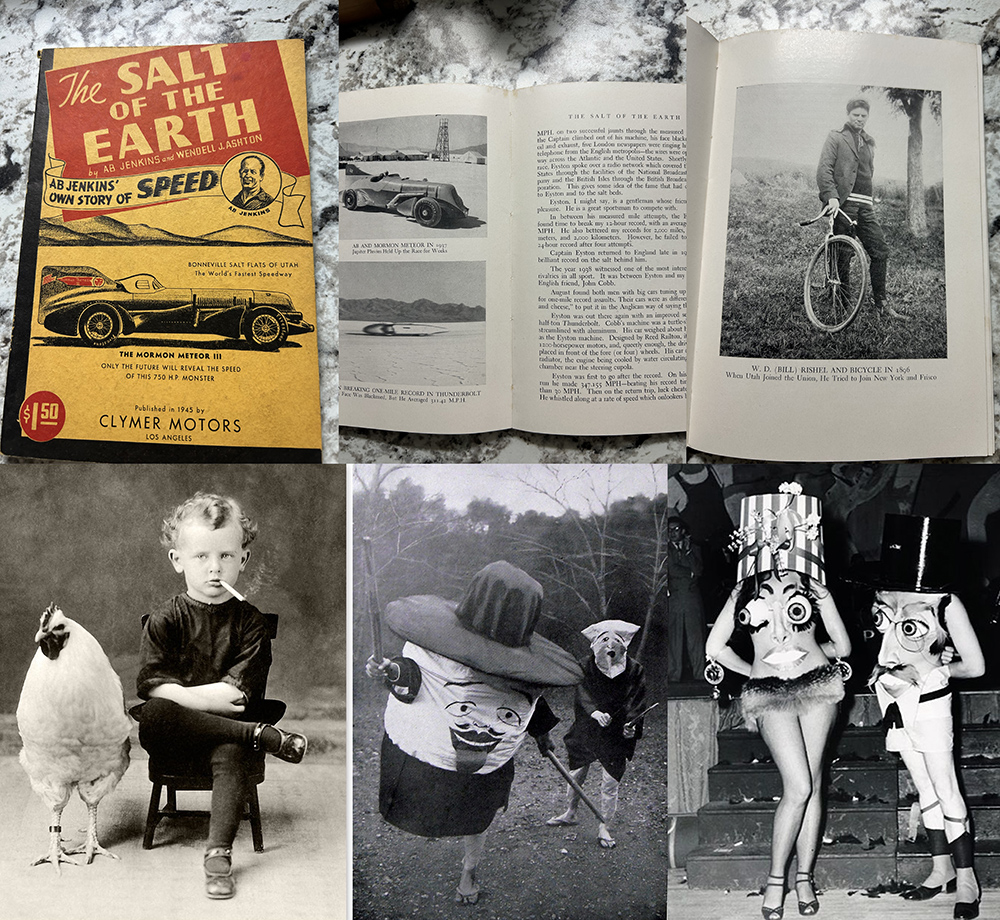
Here’s where we encounter our next batch of photos: images from a 1945 book about land speed racing at Bonneville Salt Flats. We’ve got AB Jenkins, the Mormon Meteor III, and mentions of Captain George Eyston in his Thunderbolt. These are real historical figures who did real things, which means they’re perfect victims for my fictional nonsense.
The challenge in creating absurd fiction from photographs is connecting images from completely different time periods. Bill Rishel is from 1896. AB Jenkins is from 1937. That’s a forty-one year gap. How do you bridge that?
Easy: you invent a secret society. The Velocity Cult. A organization dedicated to achieving speeds that make reality negotiable. Did it exist? Of course not. Does it explain why anyone would care about Bill’s bicycle catastrophe four decades later? Absolutely.
This is the part where I invoke the ancient writing wisdom of “just make something up and commit to it so hard that people assume you did research.”
Research Is Just Controlled Lying
Let me tell you about my “research process” for this section. I looked at a photograph of AB Jenkins and his streamlined race car. I read that he broke speed records. Then I thought, “What if he was actually racing to prevent dimensional incursions rather than just, you know, going fast for sport?”
Is there any evidence for this? None whatsoever. Did I invent an entire backstory about inherited journals from Bill Rishel containing warnings about reality becoming “squishy” at 350 MPH? You bet your ass I did.
When creating absurd fiction from photographs, you take the boring facts (man drove car fast) and you ask yourself: “What if the boring explanation is actually a cover story for something incredibly stupid?” Then you write the silly thing.
The British Complication (Every Story Needs Foreigners)
Enter Captain George Eyston, an actual historical figure who actually raced land speed cars and definitely did not open portals to alternate dimensions. But in my story, he absolutely did, because I found the photos of people in giant novelty mascot heads and needed an explanation that was somehow more disturbing than “people in the past had terrible ideas about entertainment.”
The escalation here is critical. We started with one guy and a bicycle. Now we have international speed competitions, multiple vehicles, and… this is where it gets good… accidental dimensional breaches that allow entities from alternate timelines to slip through into 1937 Utah.
This is the core technique of creating absurd fiction from photographs: every new image should raise the stakes and make the previous absurdity seem quaint by comparison. Bill disintegrated his bicycle? Cute. AB Jenkins is preventing reality itself from unraveling? Now we’re talking.
Introducing the Mascots (A.K.A. Nightmare Fuel)
Those photographs of people in giant novelty heads are doing some serious heavy lifting here. In reality, they’re probably just vintage promotional photos from some long-forgotten event. In my version, they’re temporal refugees from a dimension where wearing oversized heads is legally mandated and buildings celebrate birthdays.
Why? Because when you’re creating absurd fiction from photographs, the weirder the image, the weirder your explanation needs to be. You can’t just say “people wore costumes.” That’s boring. You have to say “these are entities from the Big Head Dimension who accidentally stumbled through a velocity-induced wormhole during the Empire State Building’s eighth birthday party in 1939 despite it being 1937.”
Does this make sense? No. Does it explain why the photos exist in my narrative? Also no. But it sounds like an explanation, which is close enough for jazz.
The Technical Jargon That Means Nothing
Notice how I threw in terms like “temporal refugees,” “velocity-induced wormhole,” and “quantum immunity”? This is what I call the “science words = credibility” technique. When you’re writing absurdist fiction, especially when creating absurd fiction from photographs, you need to occasionally sound like you know what you’re talking about even though you absolutely don’t.
I have no idea what would actually happen if someone drove 311.42 MPH. Probably tire damage and insurance issues. But in my version, that exact speed, specifically the .42 decimal, is the point where “reality stops being a fixed state and becomes more of a loose agreement between particles.”
Is this physics? No. Does it sound like it could be physics if physics had gotten really drunk and started making poor decisions? Yes, and that’s the sweet spot we’re aiming for.
Character Multiplication: More Weird People = More Weird Story
At this point in the narrative, I’ve introduced:
- Bill Rishel (bicycle teleportation enthusiast)
- AB Jenkins (land speed racer/reality defender)
- Captain George Eyston (British complication)
- Mister Building (sentient architecture from another dimension)
- Jolly Pete (sailor-dog creature with a mysterious backstory)
- Multiple generations of chickens named Duchess
This is what happens when you’re creating absurd fiction from photographs and you have too many images to work with. Every photo demands a character. That character demands a backstory. Then, every backstory demands to be weirder than the last one.
The trick is giving each character a specific purpose in your escalating madness. Mister Building isn’t just weird decoration, he represents the contamination event that explains why we have sports mascots in our timeline. Jolly Pete isn’t just a dog-sailor hybrid—he’s proof that velocity breaches have been happening since at least 1934.
Each photograph becomes evidence of your expanding universe of nonsense.
The Contamination Concept (Making Your Nonsense Matter)
Here’s where I try to inject something resembling stakes into this mess: the idea that these dimensional refugees are “contaminating” our timeline with the concept of mascot culture. Within hours of their arrival, people start getting ideas about restaurants with singing mice and theme parks staffed by people in full-body character suits.
This is the “make your absurdity explain real things” technique. When creating absurd fiction from photographs, you can increase investment by suggesting that your made-up story actually explains something about our real world. Even if that explanation is “Chuck E. Cheese is an interdimensional spy,” it gives readers a reason to care beyond “ha ha, funny bicycle story.”
Does my fiction actually explain the origin of mascot culture? Of course not. But it’s more interesting than “someone thought it would be fun to wear a costume,” and that’s the bar we’re clearing here.
Building Toward the Next Part (Fake Foreshadowing)
The end of this essay needs to set up the resolution coming in Essay 3. We’ve established the problem: dimensional breach, mascot contamination, reality becoming unstable. Now we need the solution setup.
Enter: the phone call. “Get the chicken. We need her now.”
This is pure manipulation. I’m making you think the chicken lineage I invented in Essay 1 is actually going to matter. It probably will, because I’ve written myself into a corner and the chicken is literally my only remaining narrative device, but the point is to make it seem like I planned this all along.
When creating absurd fiction from photographs, always act like your random choices were actually careful foreshadowing. Nobody needs to know you made it up as you went along. Confidence is everything.
The Escalation Checklist (For Future Reference)
If you’re following along at home and trying to apply these “techniques” to your own photo fiction, here’s what we’ve done in this middle section:
- Time jumped forty years
- Introduced real historical figures and made them fictional
- Added international complications (British people)
- Escalated from bicycle problems to dimensional breaches
- Brought in the nightmare mascot photos
- Invented scientific-sounding nonsense
- Created consequences that affect the real world
- Called back to the chicken from Essay 1
- Set up the resolution without actually knowing what it will be
This is peak middle-section storytelling: throw everything at the wallLearn how to escalate absurdist storytelling with land speed racing, dimensional breaches, and increasingly questionable narrative choices., connect it with increasingly tenuous logic, and hope the reader is too entertained to notice you’re making it up in real-time.
End of Essay 2
Next time: We resolve absolutely nothing while pretending we’ve wrapped everything up nicely. The chicken saves the day, probably. I haven’t decided yet. This is fine.
Key Takeaways
- Welcome back to the exploration of creating absurd fiction from photographs, where you escalate narratives after setting a premise.
- Connecting images from different eras requires creativity, such as inventing a secret society to bridge gaps between timelines.
- You can raise absurdity levels by introducing quirky characters, bizarre concepts, and nonsensical explanations for real-life phenomena.
- Using scientific jargon can lend credibility to absurd scenarios, even if the science is invented or poorly understood.
- Ultimately, crafting engaging stories involves making random choices seem deliberate, all while keeping readers entertained with absurdity.
Related Links

See my Amazon author page and buy my books.
His first manuscript was composed entirely of punctuation marks and confused sketches. He's since published "Not Bukowski" (poems that don't rhyme) and "Slop and Swell from a Festering Mind" (essays so concerning that bookstores check on his well-being). He once spent three hours photographing a rare bird that turned out to be a plastic bag, and he's the only person banned from church bake sales for "weaponized brownies." Inheriting absurdism from Vonnegut and Adams, sprawling narratives from Irving, and weaponized failure from Moore, he writes about conflicted everymen struggling through supernatural chaos.
He has two new, offbeat novels waiting for an agent or a publisher: "Truth Tastes Like Pennies" and "Elliot Nessie."
He remains unconvinced that birds aren't surveillance drones.
More biographic lies...err...info.
- Marrakech v. America - May 5, 2026
- They Parachuted the Beaver - May 5, 2026
- Red Eye Has Nothing to Fear - May 2, 2026